Japanese Traditional Crafts: The Officially Designated Kogei and How to Understand Them
“Japanese traditional crafts” sounds like a vague cultural category. In Japan it is also a legal one.
Since 1974 there has been a national law defining what qualifies, and only crafts meeting its conditions may carry the official designation. That single fact makes the field far easier to navigate than most visitors expect.
This guide explains the legal definition, breaks the crafts down by material and region, and gives practical advice on buying. We write as a workshop producing one of the designated crafts — Owari cloisonné — from inside the system.
What Counts as Japanese Traditional Crafts?
The Japanese word is kōgei (工芸), meaning craft or applied art. Objects meeting a national standard are called dentōteki kōgeihin (伝統的工芸品), “traditional craft products,” designated by the Minister of Economy, Trade and Industry.
This is not an honorific handed out loosely — it is an industrial designation with defined criteria, applied to a specific craft in a specific area.
The five conditions
- The item is used mainly in everyday life
- The main part of the production process is by hand
- It is made by traditional techniques or methods — meaning those with at least 100 years of history, continuing to the present
- Its principal raw materials are those traditionally used
- It is produced in a defined area by a certain number of businesses or workers, not by one isolated maker
Condition three eliminates most applicants: the technique itself needs a documented century of continuous use.
Note condition one as well. Japanese traditional crafts are legally defined as things people use, not as art objects for display. A tea bowl qualifies; a purely sculptural work generally does not. This requirement shapes the character of the whole field.
As of 27 October 2025, 244 items held the designation.
Source: Ministry of Economy, Trade and Industry, Traditional Craft Products.
The 1974 Law That Defines Japanese Traditional Crafts
The framework comes from the Act on the Promotion of Traditional Craft Industries (Act No. 57 of 1974).
The context matters. Japan’s post-war economic expansion had pulled labour into factories and cities, and regional handcraft industries were contracting sharply. The law was a response to an industrial problem, designed to keep production systems viable rather than to celebrate heritage in the abstract.
What designation provides
- Subsidies for training successors — the central difficulty in most craft regions
- Support for raw material procurement, often the hardest constraint
- Use of the official Densan mark on certified products
- Promotion and export support
- Certification of individual artisans as Dentō Kōgeishi (Traditional Craftsperson), requiring twelve or more years of practical experience and a passed examination
The Densan mark itself was designed by the graphic designer Yusaku Kamekura, combining the character 伝 (“tradition”) with a red circle representing Japan.
How this differs from “Living National Treasure”
The two are often confused. Dentōteki kōgeihin designates a regional craft industry; Living National Treasure (Ningen Kokuhō) designates an individual holder of an Important Intangible Cultural Property. The first is administered by METI as industrial policy, the second by the Agency for Cultural Affairs as cultural policy.
In practical terms: the Densan mark tells you an object was made in the designated area using the designated techniques. It says nothing about whether the maker is famous. For most buyers the first is the more useful guarantee.
Japanese Traditional Crafts by Material: The Main Families
Designated crafts are grouped by material and technique, which makes the list navigable.
| Family | Japanese term | Representative examples |
|---|---|---|
| Ceramics and porcelain | Tōjiki | Arita ware, Bizen ware, Kutani ware, Tokoname ware |
| Textiles | Orimono / Somemono | Nishijin brocade, Kyō-yūzen, Ōshima tsumugi |
| Lacquerware | Shikki | Wajima-nuri, Aizu-nuri, Kyō-shikki |
| Metalwork | Kinkōhin | Nambu ironware, Takaoka copperware, Owari shippō (cloisonné) |
| Woodwork and bamboo | Mokkōhin / Takekōgei | Hakone marquetry, Beppu bamboo basketry |
| Paper | Washi | Echizen washi, Mino washi, Tosa washi |
| Dolls and others | Ningyō / Sonota | Edo kimekomi dolls, Kyoto folding fans |
A note on the metalwork family
Ceramics, lacquer and textiles account for most international awareness of Japanese traditional crafts. Metalwork tends to be less visible abroad, partly because its products are smaller and were historically components — fittings, hardware, sword mounts — rather than standalone pieces.
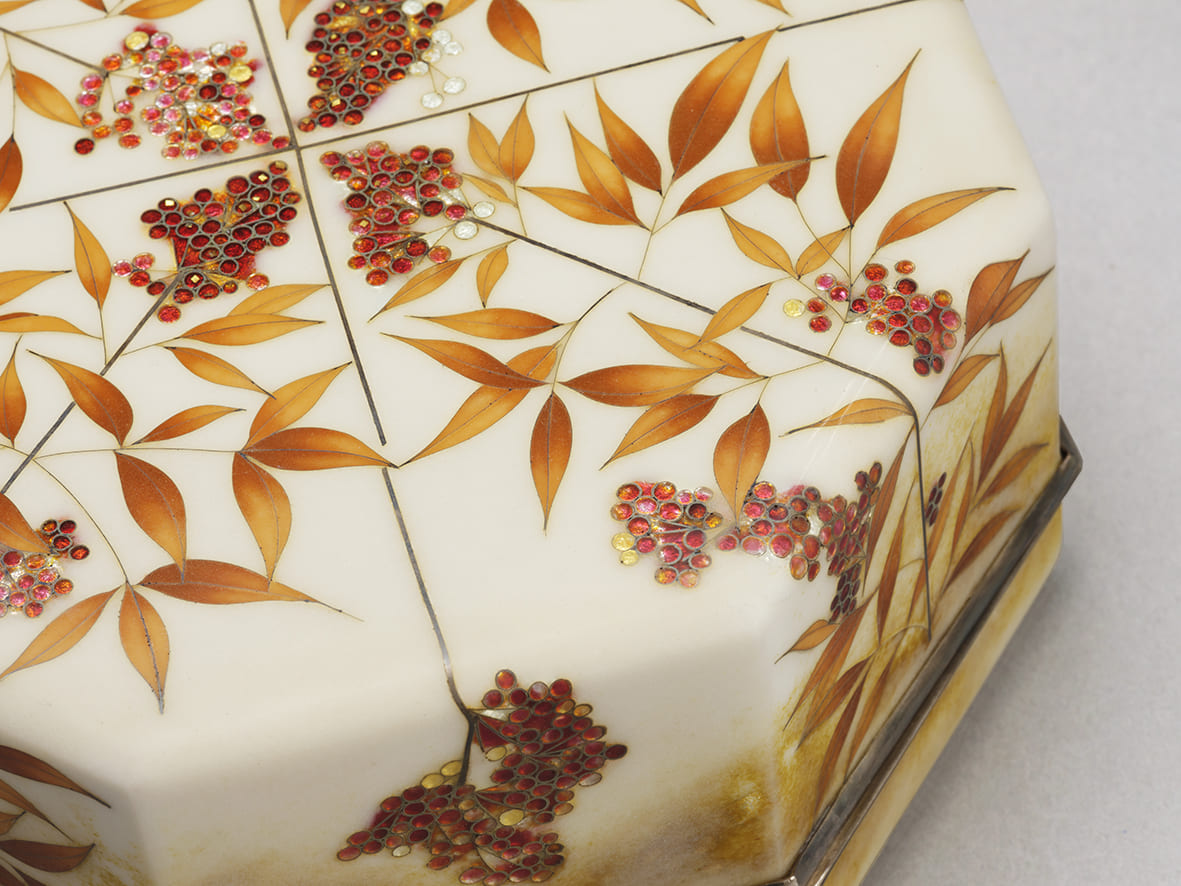
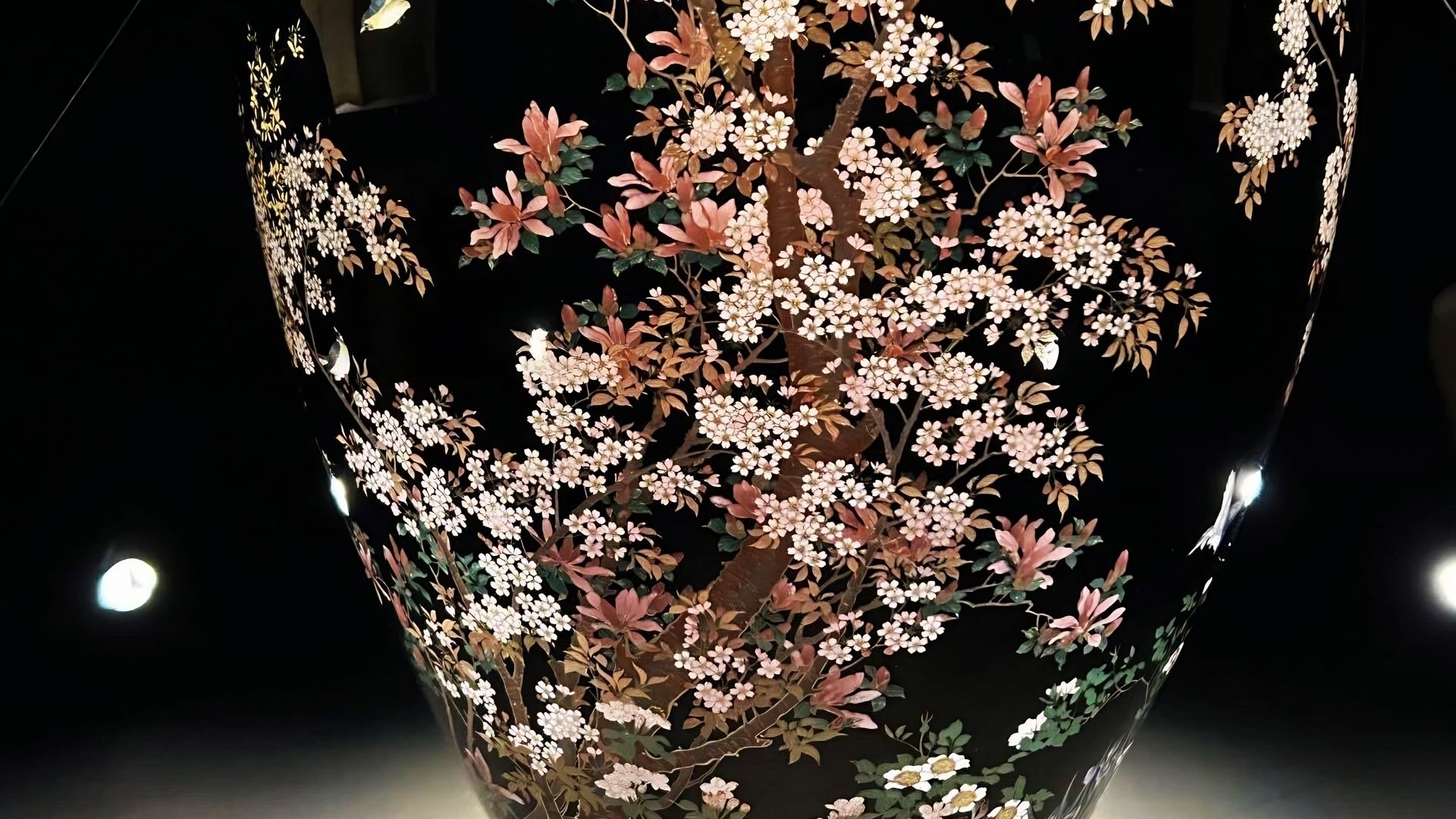
Owari shippō, produced in Ama City and Nagoya City in Aichi Prefecture, was designated on 5 April 1995 in the 29th round of designations. It is described in the prefecture’s official listing as using a copper or silver base with glass glaze, with wired shippō as the region’s representative technique.
Source: Aichi Prefecture, Traditional Crafts of Aichi — Owari Shippō.
A Regional Map of Japanese Traditional Crafts
Japanese traditional crafts are strongly local. The same broad technique in two neighbouring areas can be two separately designated crafts with different names.
North to south, in broad strokes
- Hokkaidō and Tōhoku — Nibutani ita and attus from Hokkaidō, Nambu ironware from Iwate, Tsugaru lacquer from Aomori, Kaba-zaiku cherry-bark work from Akita.
- Kantō — Edo kiriko cut glass, Edo woodblock printing, Yūki tsumugi silk. Urban, consumer-facing crafts shaped by Edo’s population.
- Chūbu — Wajima lacquer from Ishikawa, Takaoka copperware from Toyama, Seto and Tokoname ceramics and Owari shippō from Aichi, Echizen washi from Fukui.
- Kansai — Nishijin weaving, Kyō-yaki and Kiyomizu ware, Kyoto fans and Buddhist altars. Court and temple patronage produced unusually refined work.
- Chūgoku and Shikoku — Bizen ware from Okayama, Tosa washi from Kōchi, Banshū items from Hyōgo.
- Kyūshū and Okinawa — Arita and Imari porcelain from Saga, Bingata dyeing, Ryūkyū lacquer and Tsuboya ware from Okinawa.
The clustering is not sentimental. Crafts settled where their raw material was: porcelain stone at Arita, iron and casting sand in Iwate, clean water for papermaking in Echizen.
The place-name test
A useful shortcut: if a craft’s name begins with a place, that place is part of what the object legally is. Be aware, though, that designated production areas are often broader than the single town in the name — several municipalities may be included in one designation. The geography is definition rather than branding, but the boundary is the one written into the designation, not the one on the label.
Who Actually Makes Japanese Traditional Crafts Today
This is the part most guides skip, and the part that matters most.
The structural problem
The sector faces three pressures at once: an ageing artisan population, a shrinking supply of traditional raw materials, and a domestic market that changed when Japanese homes and habits changed.
Government figures show the scale plainly: total production value for designated traditional crafts fell below ¥100 billion in FY2016 and has continued to decline. Employment has followed the same curve.
Source: Ministry of Economy, Trade and Industry, briefing materials on traditional craft industries.
How production is organised
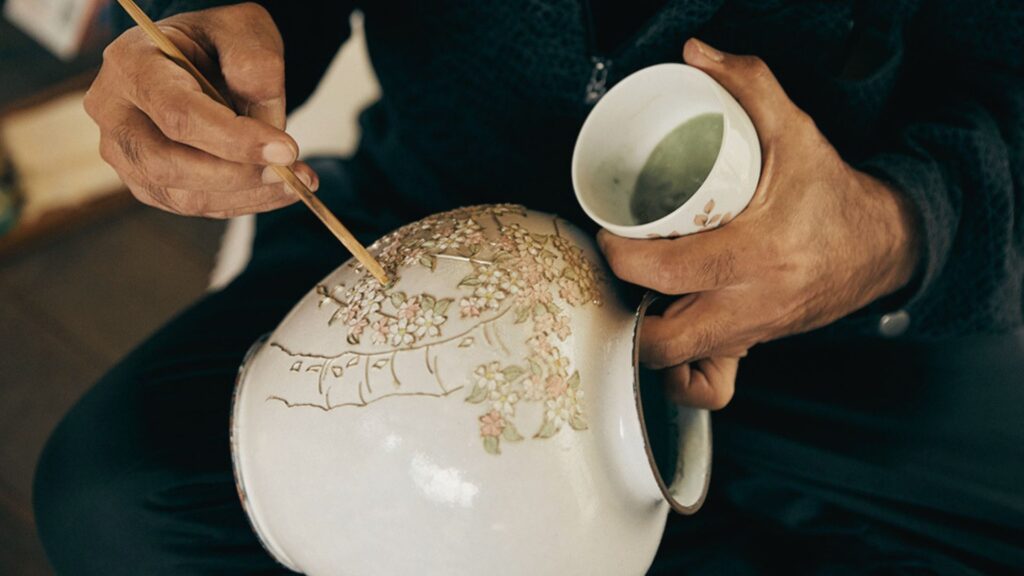
Many designated crafts are made through divided-labour workshop systems rather than by lone artists. In Owari shippō, one specialist forms the copper body, another sets the silver wires, another applies the glaze, another fires, another polishes.
This is why the law requires production by a group in a defined area rather than by an individual. Where a chain of specialists is involved, the loss of one link can stop the whole process — which is why successor training, rather than demand, is usually named as the binding constraint.
How close the margin can get
Owari shippō gives a concrete illustration. During the war, the copper, lead oxide, cobalt and manganese the craft depends on were classified as military materials, and production became extremely difficult. After 1945 the industry revived unexpectedly, because enamel proved an ideal souvenir for occupation personnel returning home: unlike wood, bamboo or paper, a metal-bodied object survived a long journey without breaking.
The producers’ cooperatives today are small. As of May 2017, the Shippō-chō cooperative had eight member businesses and the Nagoya cooperative seven.
Source: Aichi Prefecture; Japan Traditional Crafts Aoyama Square.
Japanese Traditional Crafts You Can Use Every Day
Because the legal definition requires everyday use, most designated crafts are more practical than their prices suggest.
- Nambu ironware kettle — heats evenly and lasts for decades. Note that only kettles with a bare iron interior are associated with adding dietary iron to the water; enamel-lined pots do not do this.
- Mino or Hasami ware tableware — widely produced, comparatively inexpensive, and most modern lines are made for ordinary household use
- Echizen or Mino washi — for letters, lampshades, and conservation work
- Beppu bamboo basketry — light, strong, and deepens in colour with handling
- Cloisonné jewellery — colour that comes from glass rather than pigment, at a scale that suits daily wear
The common mistake is treating a designated craft object as too precious to use, which is backwards: these things were defined by their usability and were expected to acquire wear.
A note on durability
In cloisonné the colour is glass fused to metal, not pigment applied to a surface. That is a materials difference with a practical consequence: the colour cannot rub off or bleach out the way a coating can.
The trade-off is brittleness. Glass on metal will chip under a hard impact, so enamel is made to be handled and worn but not dropped.
How to Buy Japanese Traditional Crafts Without Getting It Wrong
Practical guidance, in the order to apply it.
Check the mark
Certified products carry the Densan mark. Its presence confirms the item was made in the designated area using the designated techniques. Souvenir items that merely look traditional will not carry it.
Ask three questions
- Where was it made? A specific town or designated area, not “Japan.”
- Which stages were done by hand? Ask about the specific steps — forming, decoration, finishing — rather than asking whether it is “handmade,” which almost anything can be called.
- What is it for? Designated crafts are defined as usable objects, so there should be a clear answer.
Buy near the source where you can
Most craft regions maintain a museum or centre with an attached shop — for cloisonné, the Ama City Shippō-yaki Art Village in Shippō-chō. The main advantage is not necessarily price but information: you can usually see the technique demonstrated and ask the producers directly.
Understand what you are paying for
A hand-set cloisonné piece requires every outline to be bent, placed and glued individually before firing begins, and a mid-size vase can take weeks in our workshop. When a traditional-looking piece is surprisingly cheap, the difference is usually in how many hand stages were replaced by transfer printing, casting, or machine finishing.
Across most craft families, one habit serves well: look at the object at its hardest point — the tightest curve, the thinnest line, the sharpest corner — because that is where shortcuts show first.

TAMURA-SHIPPO 田村七宝工芸
Founded in Meiji 16 (1883). We are a kiln located in Shippo-cho, Ama City, Aichi Prefecture, specializing in “Owari Shippo,” a traditional craft designated by the Ministry of Economy, Trade and Industry. We continue to produce Shippo ware in order to preserve this beautiful traditional culture. The content of this article has been fully supervised by Tamura Shippo Kogei (with AI-generated summaries included), and has been proofread with reference to reliable books and government media sources.