Japanese Pottery and Ceramics: The Major Kilns, Styles, and How to Tell Them Apart
Japanese ceramics do not organise themselves neatly. A wood-fired Bizen jar with no glaze at all and a hand-painted Kutani plate with five overglaze colours are both Japanese pottery.
What connects them is not a look but a set of shared reference points: particular kilns, particular clays, and centuries of disagreement about what makes a good pot.
This guide covers the vocabulary, the main historical kilns, the split between pottery and porcelain, and how to tell the major styles apart. We write from a kiln in Aichi that fires something adjacent but different — glass onto metal rather than clay — and close with a note on where that sits alongside ceramics.
Japanese Pottery and Ceramics: The Basic Vocabulary
A few Japanese terms remove most of the confusion in English-language descriptions.
| Term | Meaning |
|---|---|
| Tōki (陶器) | Pottery — earthenware and stoneware. Opaque, clay-bodied |
| Jiki (磁器) | Porcelain. Porcelain stone or kaolin, high-fired, often translucent |
| Tōjiki (陶磁器) | The umbrella term for both |
| Yakimono (焼き物) | Everyday word for fired ware |
| -yaki (焼) | Suffix meaning “ware,” attached to a place name |
The tōki–jiki distinction predicts most of what follows: weight, sound, translucency and handling.
The quick physical test
- Pottery — heavier for its size, opaque, dull when tapped, foot ring often rough and unglazed
- Porcelain — thinner and lighter, may transmit light at the rim, rings when tapped, smooth white body
The “-yaki” suffix names a place, not a material, and several regions produce both. Seto in Aichi is the standard example, having made pottery for centuries before adding porcelain in the 19th century.
A Short History of Japanese Pottery and Ceramics
A few turning points explain most of what came later.
Jōmon and Yayoi
The Jōmon period produced some of the oldest known pottery anywhere, coil-built and low-fired, decorated with the cord markings that name the period. The Yayoi pottery that followed is plainer and thinner.
Continental technology arrives
From roughly the 5th century, kiln technology and the potter’s wheel reached Japan from the Korean peninsula, producing hard grey sue ware. The sloping climbing kiln, capable of far higher temperatures than open firing, is the technical break everything afterward depends on.
The tea ceremony reshapes taste
From the 15th and 16th centuries, the development of wabi-cha under figures including Sen no Rikyū (1522–1591) shifted value away from imported Chinese perfection and toward irregularity, restraint and surfaces marked by the fire.
This is where Japanese ceramic taste separates from Chinese and European taste, and the effects remain visible in what Japanese kilns make now.
Porcelain and export
Porcelain production began in the Arita area in the early 17th century after suitable stone was found there. When political upheaval disrupted Chinese exports mid-century, Japanese porcelain reached the European market in quantity, shipped through the port of Imari.
The Six Ancient Kilns of Japanese Pottery
The Rokkoyō, or Six Ancient Kilns, is a grouping proposed in the twentieth century by the ceramic scholar Koyama Fujio for medieval kiln sites producing continuously from around the Heian and Kamakura periods.
| Kiln | Prefecture | Character |
|---|---|---|
| Seto | Aichi | Technically varied; historically the main glazed-ware centre |
| Tokoname | Aichi | Iron-rich reddish clay; storage jars, later teapots |
| Echizen | Fukui | Unglazed, robust storage vessels |
| Shigaraki | Shiga | Coarse clay with visible feldspar grains; orange scorching |
| Tanba | Hyōgo | Long wood firings producing natural ash glaze |
| Bizen | Okayama | No glaze; surface comes from fire, ash and straw |
The grouping is a modern scholarly framework rather than a historical association, and the list has been debated since it was proposed — other medieval kiln sites have strong claims. It stays useful because these kilns share a quality: unglazed or minimally glazed stoneware made for ordinary use, later reinterpreted as art.
Bizen as the clearest case
Bizen uses no glaze. All surface variation — reddish scorching, ash deposits, straw-wrapping marks — comes from what happens during a firing that can run for days. Two pieces of the same clay placed a metre apart can emerge looking entirely different, which is the point rather than a problem.
Porcelain in Japanese Pottery and Ceramics
Porcelain arrived late in Japan relative to China and Korea, then developed quickly.
Arita and Imari
Arita in Saga Prefecture is where Japanese porcelain production began. Because the ware shipped from the nearby port of Imari, European collectors called it Imari — so the two names often describe the same tradition from different ends.
The main porcelain styles
- Sometsuke — blue-and-white underglaze cobalt, the base language of Japanese porcelain
- Kakiemon — sparse overglaze enamel on a milky white ground, with deliberate empty space; widely copied in Europe
- Ko-Imari — dense, gold-heavy export style of the 17th and 18th centuries
- Nabeshima — made for presentation by the ruling clan rather than for sale; restrained and technically exacting
- Kutani — Ishikawa Prefecture; bold overglaze palettes, historically strong greens, yellows and purples
The distinction that matters when buying is underglaze versus overglaze: underglaze blue sits beneath the glaze and cannot wear off, while overglaze enamels sit on top and can be abraded by hard scrubbing or repeated dishwasher use.
Japanese Pottery and Ceramics Made for the Tea Ceremony
Tea ceramics are judged by different criteria from tableware.
Raku
Raku ware is hand-shaped without a wheel, fired at relatively low temperature and removed from the kiln while hot. The Raku family line traces to the 16th century and to work associated with Sen no Rikyū, and the bowls are deliberately plain, thick-walled and comfortable in the hands.
Mino wares: Shino, Oribe, Ki-Seto
- Shino — thick white feldspathic glaze, often with pinholes and an orange blush where the glaze thins
- Oribe — bold copper-green glaze with asymmetric forms, associated with the tea master Furuta Oribe (1544–1615)
- Ki-Seto — soft yellow glaze with a slightly dry surface
What tea taste values
Tea ceramics are assessed by how a bowl behaves in use — weight in the hand, how the rim meets the lip, how tea colour reads against the glaze — rather than by decorative appeal alone.
This is why an apparently rough bowl can be highly valued, and why Japanese ceramic vocabulary contains so many terms for controlled irregularity. It is a different evaluative system, not simply a preference for rustic things.
How to Identify Japanese Pottery and Ceramics by Style
A practical sequence.
- Check the body. White, fine and dense indicates porcelain; grainy or coloured indicates pottery.
- Look at the unglazed foot. The foot ring usually shows raw clay, which is the clearest single regional clue.
- Ask where the surface came from. Applied glaze, painted decoration, or effects produced by the fire?
- Look for a mark, but do not rely on it. Many Japanese wares are unmarked, and popular styles were widely imitated in Japan and abroad.
- Assess the decoration. Hand-painted brushwork varies between pieces; transfer printing repeats exactly.
Quick style indicators
- No glaze, reddish-brown, ash marks → likely Bizen
- Coarse body with white grains, orange scorch → likely Shigaraki
- Thick white glaze with pinholes → likely Shino
- Strong copper green, asymmetric form → likely Oribe
- White porcelain with blue painting → sometsuke
- Dense gold and red overglaze → Ko-Imari style
Treat these as starting hypotheses. Styles were copied across regions and centuries, and attributing older pieces is specialist work.
Buying and Caring for Japanese Pottery and Ceramics
Most Japanese ceramics are made to be used.
Before buying
- Pick it up. Balance and weight are a substantial part of what a Japanese potter designs for.
- Check porosity. Unglazed or low-fired pottery absorbs liquid and needs different care from porcelain.
- Ask about dishwasher and microwave use. Modern production wares are often suitable; overglaze enamel and gilding usually are not.
Care basics
- Porous pottery is often soaked in water before use so it absorbs less food liquid
- Avoid sudden temperature changes; boiling water into a cold thick-walled piece risks cracking
- Dry thoroughly before storing, as trapped moisture in a porous body can cause odour
- Do not scour overglaze enamel or gilding
On repair
Kintsugi, repairing broken ceramics with lacquer and gold, is a genuine tradition, but it is slow specialist work using urushi lacquer rather than the quick adhesive kits sold under the name. Urushi can also cause skin reactions.
The underlying idea travels regardless: in this tradition, an object’s history of use is treated as part of what it is rather than as damage to conceal.
Beyond Japanese Pottery and Ceramics: A Note from a Cloisonné Kiln
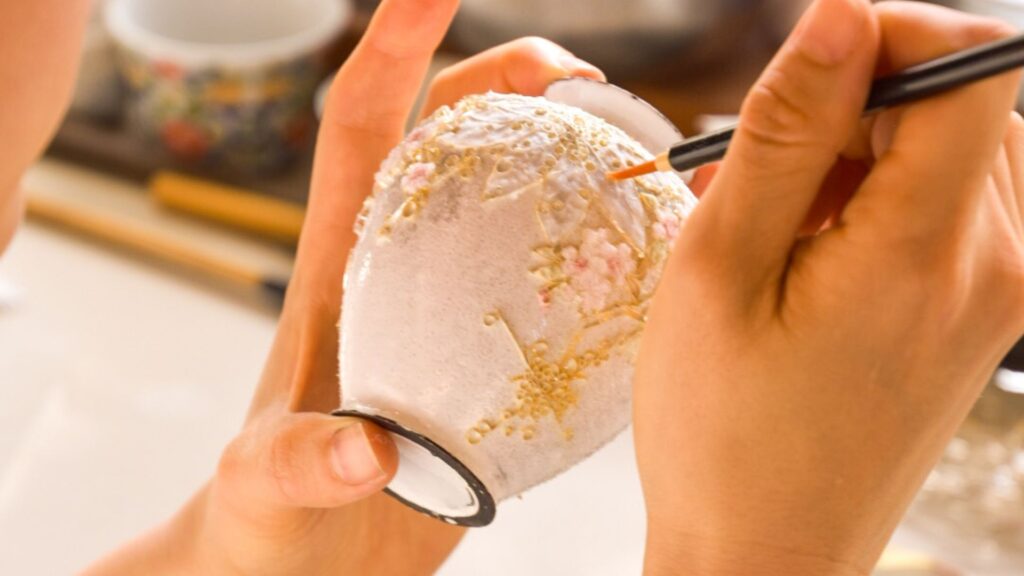
A word about where this guide is written from. We are Tamura Shippo Kogei, a workshop in Shippō-chō, Ama City, Aichi Prefecture, founded in 1883 and now in its fifth generation. We are a kiln, but not a pottery — what we fire is shippō-yaki, Japanese cloisonné enamel, which belongs to a different craft category.
Why cloisonné is not ceramics
Shippō-yaki is classified in Japan as metalwork. The base is copper or silver, formed before decoration begins. Powdered glass glaze is applied and fired at around 800°C, repeated in layers until the surface is built up, then ground and polished by hand.
| Japanese pottery and ceramics | Shippō-yaki | |
|---|---|---|
| Base | Clay | Copper or silver |
| Glaze | Mineral; fuses with the clay body | Powdered glass; sits on the metal |
| Firing | Roughly 1,100–1,300°C | Around 800°C |
| Category | Ceramics (tōjiki) | Metalwork (kinkōhin) |
| Failure mode | Cracks and shatters | Chips at the glass layer |
The temperature gap is structural rather than a matter of difficulty: copper melts at about 1,085°C, so enamel works inside the band where glass flows and metal does not. A potter can raise the kiln temperature to get an effect. We cannot.
What ceramics can do that enamel cannot
Worth stating in this direction first. Ceramics has a range of surface that enamel does not. A Bizen jar’s markings come from days in a wood kiln and are never repeated. Shino’s pinholes, Oribe’s running green, the raw clay showing at a tea bowl’s foot — none of these has an equivalent in our material.
Ceramics also has scale and everyday robustness. A rice bowl is used twice a day for a decade; enamel is not the material for that job.
What enamel does differently
The distinctive property is that the colour is glass rather than pigment or mineral glaze, with two consequences a ceramic surface does not share.
First, transparent glaze over metal changes with the light. The glass layer is translucent and the metal beneath reflects, so colour reads differently as you move around the piece. A glazed pot has a fixed appearance; an enamel surface has a variable one.
Second, the design is drawn in metal before any colour exists. In wired cloisonné every outline is a flat silver ribbon bent by hand and set upright on the body, with glaze placed inside those compartments afterward. The line and the colour are separate physical things, where in ceramics they are usually the same brushstroke.
Where the two traditions meet
They share more than the comparison suggests. Both are regional, both work through repeated firings, both were reshaped by the Meiji export market, and both sit in the same national framework — Owari shippō was designated a Traditional Craft Product on 5 April 1995, alongside ceramic crafts from the same prefecture such as Seto and Tokoname.
Both also depend on the same thing: enough people in one place who still know each stage.
If this guide has made Japanese ceramics more legible, the same habits carry over to enamel — look at the foot, look at the tightest curve, look across the surface at a low angle. The materials differ; what careful work looks like does not.
Source: Aichi Prefecture, Traditional Crafts of Aichi — Owari Shippō.

TAMURA-SHIPPO 田村七宝工芸
Founded in Meiji 16 (1883). We are a kiln located in Shippo-cho, Ama City, Aichi Prefecture, specializing in “Owari Shippo,” a traditional craft designated by the Ministry of Economy, Trade and Industry. We continue to produce Shippo ware in order to preserve this beautiful traditional culture. The content of this article has been fully supervised by Tamura Shippo Kogei (with AI-generated summaries included), and has been proofread with reference to reliable books and government media sources.