Iki: The Japanese Aesthetic of Effortless Style and Urban Sophistication
Iki is the Japanese aesthetic term least likely to appear in a guide to Zen-inspired minimalism, which is part of what makes it interesting.
It did not come from temples or tea houses. It came from the merchants, actors and townspeople of Edo — a worldly, urban sense of style that had to work within strict limits on visible luxury.
This guide explains what iki means today, how the philosopher Kuki Shūzō analysed its Edo-period form, and how it differs from wabi-sabi and shibui.
What Does Iki Mean in Japanese?
Iki (粋) describes a kind of stylishness: chic, worldly, understated, and carried off without visible effort. It is a compliment about how someone conducts themselves as much as about how something looks.
The character 粋 carries a sense of the refined or essential part of something. Iki is inseparable from an attitude — a light touch, a refusal to try too hard, and a sense of what a situation actually calls for.
How the word is used today
- Iki na hakarai (粋な計らい) — a well-judged gesture; doing the right thing without making a production of it
- Of dress: understated, well-cut, classic; put together but not laboured over
- Of a person: unfussy, relaxed, with a lightness that reads as confidence
- Of design: spare, crisp, with one detail that shows judgement
Iki na hakarai is one of the most familiar set phrases built on the word, and it concerns tact and judgement rather than style at all. An English speaker who meets the term through aesthetic writing will rarely encounter this side of it.
Visible effort undoes iki. A perfectly composed outfit that clearly took an hour is not iki; the same outfit worn as though thrown on is. The same applies to gestures: a kindness that announces itself stops being iki na hakarai.
The word is also read as sui in the Kansai tradition, where the associated sensibility differs from Edo’s — a reminder that iki is regionally specific rather than national.
Where the Japanese Concept of Iki Came From
Iki is a product of the Edo period (1603–1868), and specifically of Edo the city.
The social conditions
Edo’s merchant class accumulated wealth while ranking low in the official social order, and successive sumptuary laws restricted what commoners could display. The result was a culture of concealed quality: plain outer garments with expensive linings, subdued colours achieved through costly dyeing, refinement that only an informed eye would catch.
When display is restricted, discrimination becomes the thing worth having — and iki is the word for having it.
Where the term was worked out
Iki developed largely in the entertainment districts — the theatres, teahouses and pleasure quarters — and the scholarly literature on the term is closely tied to that world.
What carried over into general use is the underlying judgement: in a social setting where being too direct was crude and being too detached was dull, iki named the point between them. That balance is still what the word rewards.
Kuki Shūzō and the Japanese Analysis of Iki
The best-known systematic definition is The Structure of Iki (Iki no kōzō), published in 1930 by the philosopher Kuki Shūzō (1888–1941).
Kuki had studied in Europe, including with Heidegger, and wrote partly to argue that iki was a sensibility European aesthetic categories could not capture. His subject was the sensibility of Edo’s entertainment districts specifically.
His three components
| Component | Japanese | Kuki’s sense |
|---|---|---|
| Allure | Bitai (媚態) | A pull toward another person held in suspension, never resolved |
| Spirit | Ikuji (意気地) | Pride and self-possession; refusing to yield |
| Detachment | Akirame (諦め) | A worldly lightness; not clinging to outcomes |
In Kuki’s structure the three constrain each other: ikuji rules out anything servile, and akirame supplies the lightness that keeps the whole from becoming earnest.
How to treat this analysis
Kuki’s account is the most influential formulation of iki, and it is one philosopher’s interpretation, written in 1930, of an Edo-period sensibility. Later scholars have questioned both his framework and the nationalist context in which he wrote.
Cite it as an important historical reading rather than as the meaning of the word. Contemporary usage has moved some distance from his model.
Iki and Its Opposite in Japanese: Yabo
Iki is easiest to grasp through what it is not.
The direct opposite is yabo (野暮): unrefined, boorish, clumsy in the social sense — missing the point of a situation.
What counts as yabo
- Explaining something everyone present already understood
- Displaying wealth or knowledge unprompted
- Over-earnestness where lightness was called for
- Trying visibly hard to appear stylish
- Pointing out that you did someone a favour
Most of these are failures of judgement rather than of taste. Yabo is usually about misreading a situation, not about owning the wrong things.
Two related terms mark the ends of the scale: jimi for the plain and drab, hade for the flashy. Iki sits between them, which is a narrower target than it sounds.
How Japanese Iki Appears in Dress and Design
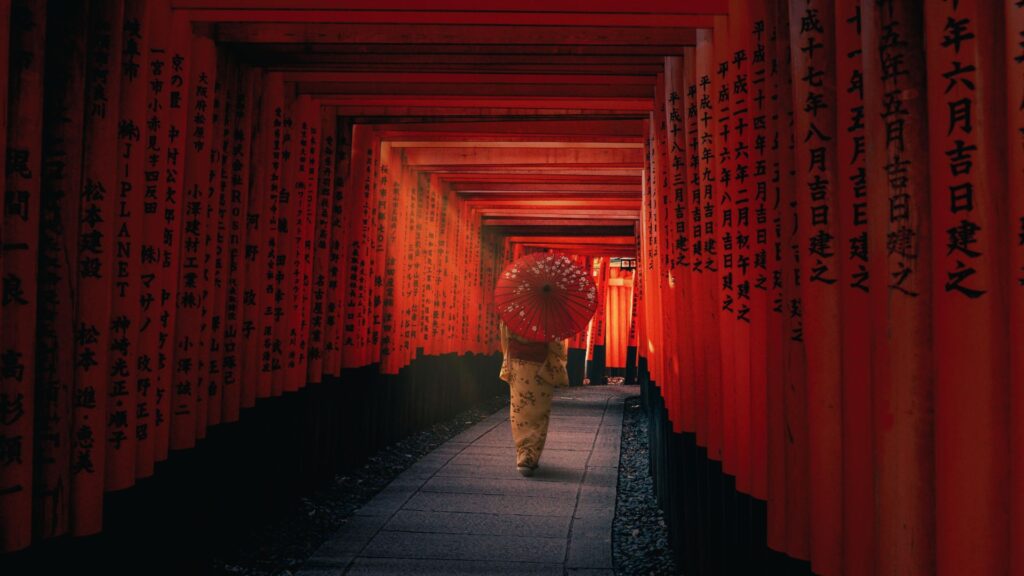
Iki has concrete visual expressions, though the attitude matters more than the checklist.
In traditional dress
- Restrained outer colours — greys, browns, indigos and blacks, with the depth expensive dyeing gives
- Concealed extravagance — a plain kimono with an elaborate lining, visible only in movement
- Fine stripes and small repeating patterns — plain at a distance, detailed up close
- A single deliberate asymmetry — one element slightly off, on purpose
Kuki associated vertical stripes with iki in particular, on the reasoning that parallel lines never converge.
In objects
An iki object tends to be spare in form with one point of quality that is not immediately obvious: a finish, a fitting, a lining, a detail on the underside.
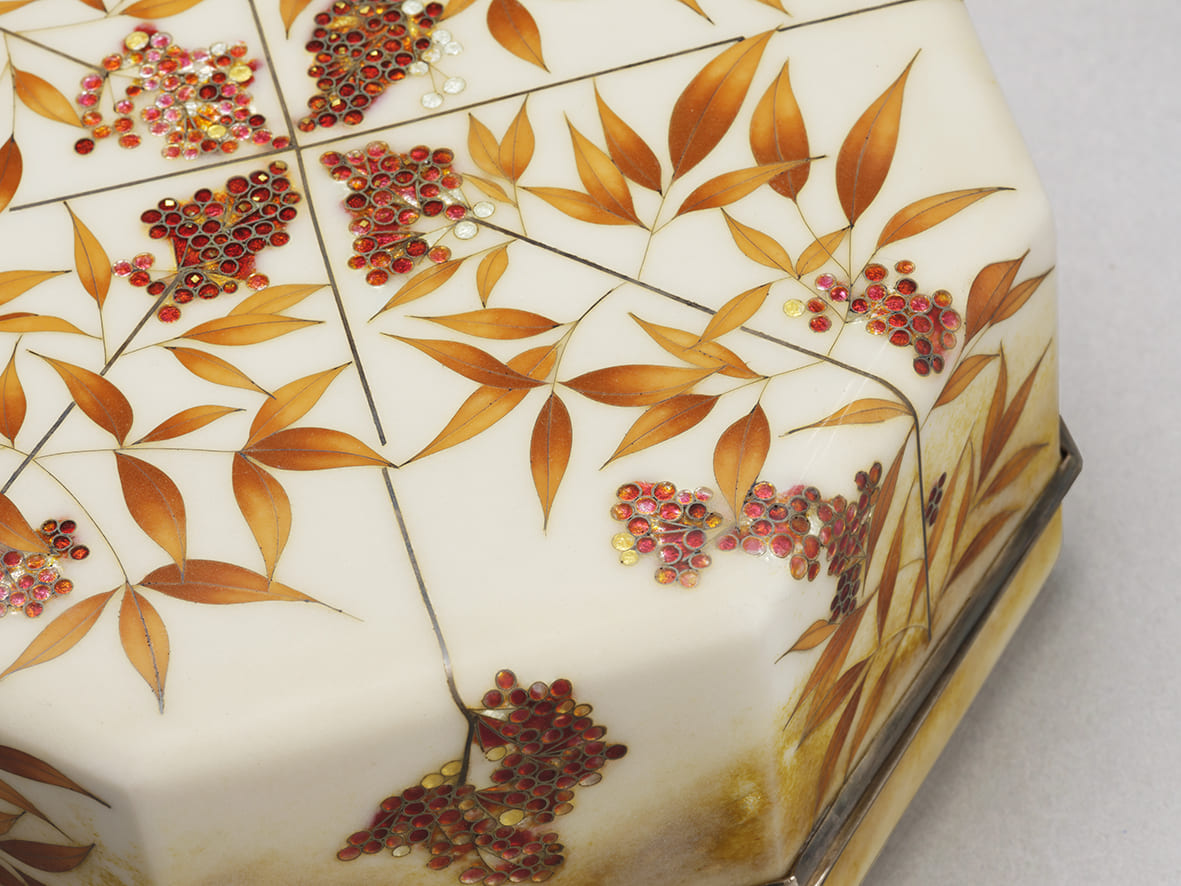
In enamel work this becomes a decision about where effort is placed. A piece decorated intensively across every visible face reads as generous but not iki; a plain piece with one precisely handled detail is closer to it.
Iki rewards the person who looks twice, and does not punish the person who does not.
Iki Compared with Other Japanese Aesthetic Terms
English-language sources routinely blur these terms. They belong to different worlds.
| Term | Where it comes from | Core quality |
|---|---|---|
| Iki | Edo urban commoner culture | Chic, worldly, unlaboured; also tactful and well-judged |
| Shibui | Tea culture, broadened in the Edo period | Restrained, quietly deep, improving with time |
| Wabi-sabi | Tea ceremony and Buddhist thought | Beauty in imperfection, transience, age |
| Miyabi | Heian court culture | Courtly elegance, polish, refinement |
Social setting separates them most clearly: wabi-sabi belongs to the tea room, miyabi to the court, and iki to the street, the theatre and the merchant quarter.
Shibui is the nearest neighbour, and the two overlap in preferring restraint. The difference is that shibui is largely indifferent to being noticed, while iki carries a lightness and a wit that shibui does not.
Why Japanese Iki Is Hard to Translate — and Still Useful
No single English word covers the range. “Chic” gets the style but loses the tact; “cool” gets the effortlessness but loses the refinement; “sophisticated” sounds too formal for a word this light.
What tends to be lost
- The everyday usage. English discussions are almost entirely aesthetic, while iki na hakarai concerns tact and judgement.
- The class history. Iki is a commoner aesthetic formed under legal restrictions on display, not an aristocratic one.
- The lightness. English renderings tend toward the formal; iki is closer to relaxed and unforced.
Why it is still worth knowing
Iki names something recognisable but hard to label: the difference between someone who looks good and someone who looks good without appearing to have tried.
It also works as a corrective to the standard export version of Japanese aesthetics. Alongside the tea room and the rock garden, Edo produced a sharp, urban, unpretentious sense of style, and iki is the word for it.
Its best-known scholarly definition describes a specific Edo-period milieu, while the living word has become broader and lighter.
TAMURA-SHIPPO 田村七宝工芸
Founded in Meiji 16 (1883). We are a kiln located in Shippo-cho, Ama City, Aichi Prefecture, specializing in “Owari Shippo,” a traditional craft designated by the Ministry of Economy, Trade and Industry. We continue to produce Shippo ware in order to preserve this beautiful traditional culture. The content of this article has been fully supervised by Tamura Shippo Kogei (with AI-generated summaries included), and has been proofread with reference to reliable books and government media sources.