Crane Symbolism in Japan: Longevity, Marriage, and the Thousand Paper Cranes
The crane is among the most widely used motifs in Japanese visual culture, appearing on wedding kimono, gift envelopes, folded paper and corporate logos.
Its two main meanings — long life and lifelong partnership — come from different sources: one from a saying, the other from the birds’ actual behaviour.
This guide covers what the crane means, where those meanings come from, the story behind the thousand paper cranes, and how the motif is used today. We work with it regularly as a Japanese enamel workshop.
Crane Symbolism in Japan: What the Bird Represents
- Longevity — the dominant meaning, from a well-known saying
- Marital fidelity — from the birds’ long-term pair bonding
- Good fortune — general auspiciousness, especially paired with the tortoise
- Peace — a twentieth-century association
- Elegance — from the bird’s appearance and courtship display
The saying behind the longevity meaning
The phrase tsuru wa sennen, kame wa mannen — “the crane a thousand years, the tortoise ten thousand” — is the source of the longevity association and is widely known in Japan.
The figures are symbolic rather than zoological. Red-crowned cranes have been recorded living into their thirties in the wild and longer in captivity, which is long for a bird but not a thousand years.
Because crane and tortoise are paired in the saying, the two motifs are frequently used together, and seeing them combined is a strong indication an object was made for a celebratory occasion.
The Real Cranes Behind Crane Symbolism in Japan
The red-crowned crane
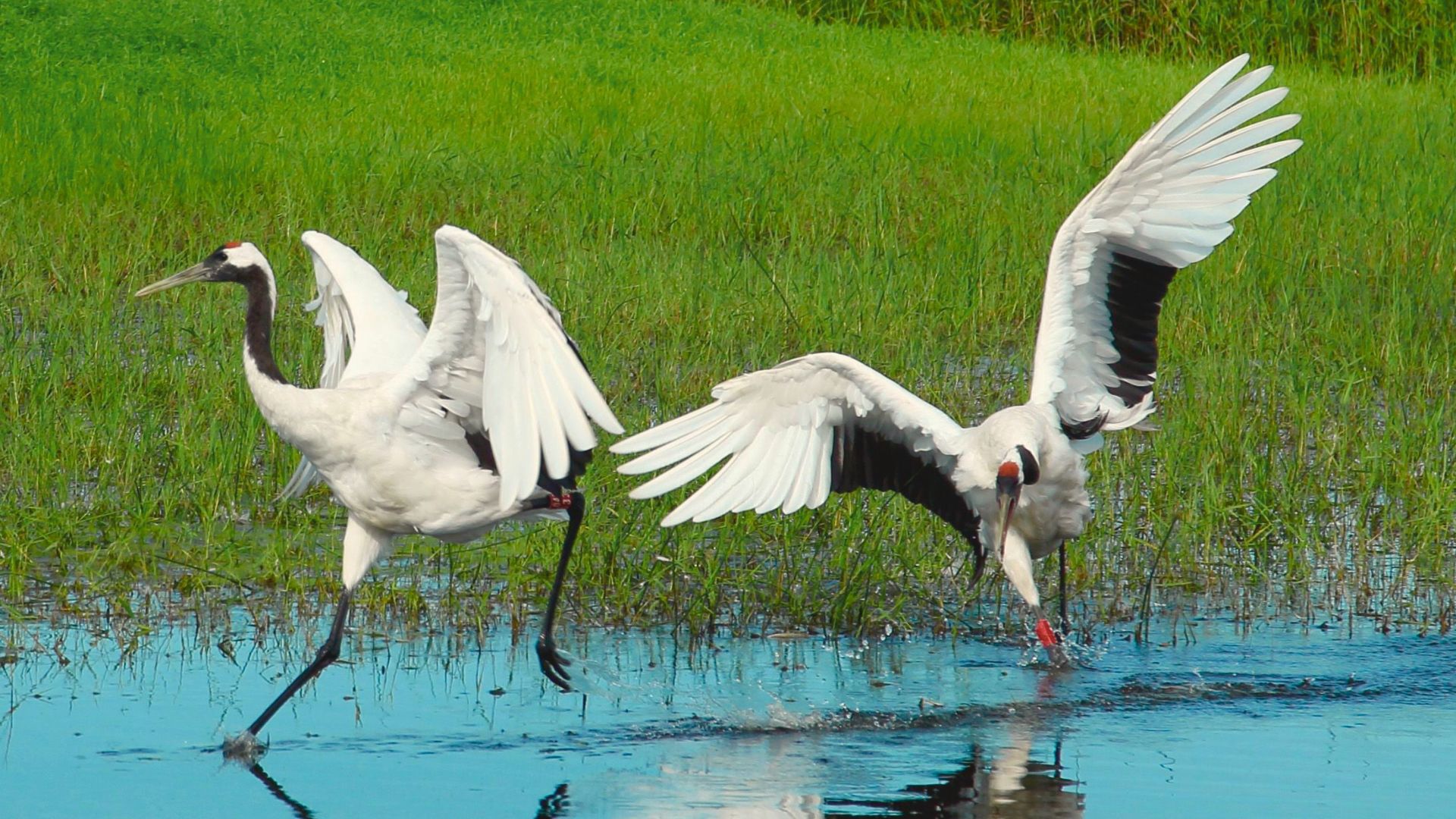
The species most associated with the imagery is the red-crowned crane (tanchō, Grus japonensis), white with black wing feathers and a patch of bare red skin on the crown.
A resident population lives in eastern Hokkaidō, particularly around the Kushiro wetlands. The species was thought to be near extinction in Japan in the early twentieth century before a small surviving group was found and protected, and the population has recovered substantially since. It is designated a Special Natural Monument.
The behaviour behind the fidelity meaning
Cranes form long-term pair bonds and perform synchronised courtship dances in which the pair leap, bow and call together. This is directly observable and is the basis for the marital association.
It is also why crane imagery so often shows two birds rather than one — a pair is the specific reference, not decorative doubling.
Crane Symbolism in Japan and the Thousand Paper Cranes
Senbazuru
Senbazuru (千羽鶴) means one thousand folded cranes, usually strung together in bunches. The tradition holds that folding a thousand accompanies a wish, commonly for recovery from illness.
Paper crane folding has a long history in Japan; an eighteenth-century book on folding connected cranes is among the earliest known origami publications.
Sadako Sasaki
The international peace association has a specific origin. Sadako Sasaki (1943–1955) was exposed to radiation as a small child in the Hiroshima atomic bombing and later developed leukaemia; while in hospital she folded paper cranes.
After her death, a campaign by her classmates led to the Children’s Peace Monument in Hiroshima Peace Memorial Park, unveiled in 1958. Chains of folded cranes are sent there from around the world and displayed near the monument.
This is a twentieth-century layer added to the older meanings of longevity and good fortune. Details of Sadako’s story vary between retellings, and Hiroshima’s own institutions are the most reliable source.
Crane Symbolism in Japanese Weddings
Where it appears
- Uchikake and shiromuku — the outer robes worn by brides in traditional weddings frequently feature cranes
- Mizuhiki — decorative cord on gift envelopes, sometimes tied into crane forms
- Ceremonial tableware and sake vessels
- Gifts to the couple
Why it fits weddings
The crane carries both meanings a wedding wants at once: a long life and a partnership that lasts. Few other motifs cover both, which is why it has remained standard.
For anyone choosing a gift for a Japanese wedding without knowing the conventions well, a crane motif is a straightforward choice.
Crane Symbolism in Japanese Art and Craft
Common treatments
- Textiles — woven or dyed on kimono and obi, often flying in groups
- Lacquer — in gold maki-e on boxes and trays
- Ceramics — painted on porcelain, particularly blue-and-white
- Metalwork and enamel — as an outlined figure with coloured infill
- Family crests — many kamon use stylised cranes, often within a circle
Why the crane suits enamel work
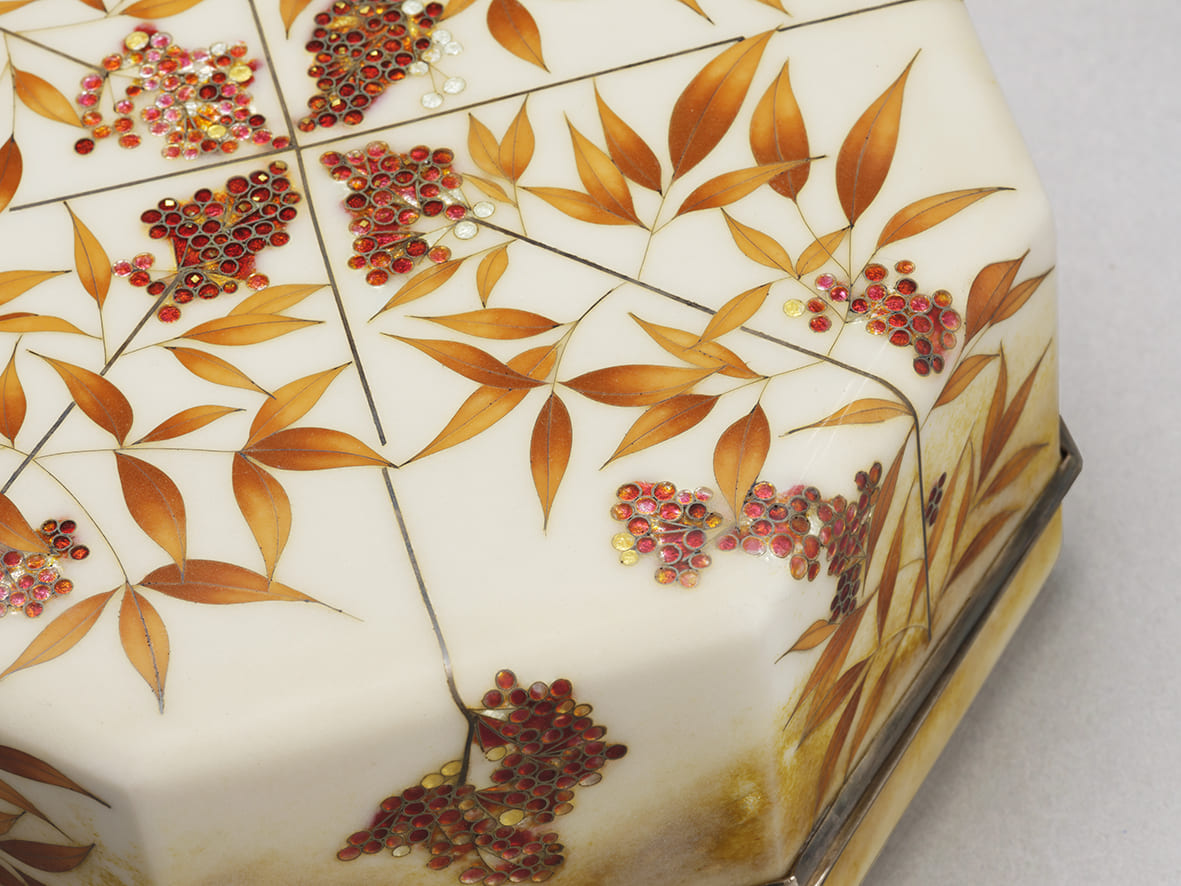
In wired cloisonné, every outline is formed from a thin silver ribbon bent by hand and set upright before glaze is applied. The crane’s silhouette — long unbroken curves through the neck, wings and legs — suits that technique, because the wire follows those lines continuously rather than being interrupted at corners.
The colour scheme works with the material as well: the black-and-white body sits well against transparent glazes, and the red crown provides one small point of saturated colour.
Motif choices in craft are often shaped by what a technique executes cleanly, not by meaning alone — and the crane satisfies both.
Cranes in Japanese Folktales
Tsuru no Ongaeshi
Tsuru no ongaeshi, “the crane’s return of a favour,” is one of the best-known Japanese folktales. A man frees a trapped crane; a woman later arrives at his home and weaves extraordinary cloth on condition that he never watch her work. He eventually looks, discovers she is the crane weaving with her own feathers, and she leaves.
Versions differ — in some she is a wife, in others a daughter — and the story is known under several titles.
What the story contributes
- Repayment of kindness — the theme of ongaeshi, recurring widely in Japanese folktales
- The broken promise — a structure found across many tales, where looking is the transgression
- Self-sacrifice — the crane is destroying herself to produce the cloth
The tale adds a note of poignancy that the auspicious readings alone do not carry.
Using Crane Symbolism in Japan Appropriately Today
Established uses
- Weddings and anniversaries
- Milestone birthdays — the longevity reading
- Retirement and long service
- Recovery wishes — particularly folded cranes
- New Year
Where care is needed
Sending folded paper cranes to Hiroshima is a real practice, and the city publishes guidance on how to send them — worth following rather than improvising.
The peace association is also strong enough internationally that a crane motif may be read politically in some public contexts, even where longevity was intended.
The general point
The crane’s meanings are consistently positive across contexts, seasons and levels of formality, which is why it has remained in constant use and why it is a default choice when an occasion matters.

TAMURA-SHIPPO 田村七宝工芸
Founded in Meiji 16 (1883). We are a kiln located in Shippo-cho, Ama City, Aichi Prefecture, specializing in “Owari Shippo,” a traditional craft designated by the Ministry of Economy, Trade and Industry. We continue to produce Shippo ware in order to preserve this beautiful traditional culture. The content of this article has been fully supervised by Tamura Shippo Kogei (with AI-generated summaries included), and has been proofread with reference to reliable books and government media sources.