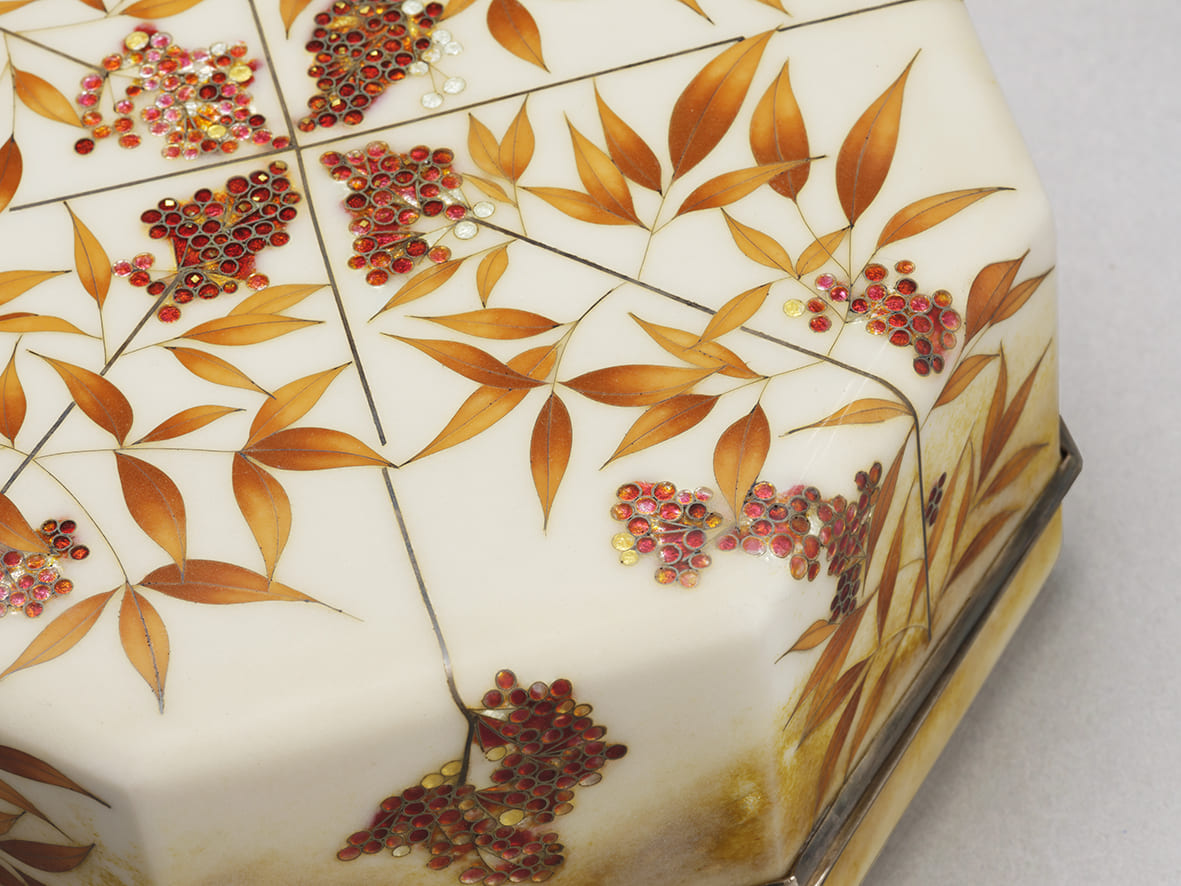
Antique Japanese Cloisonné Marks: How to Read Them and Why Most Pieces Have None
The first thing to know about antique Japanese cloisonné marks is that most pieces do not have one. Unsigned examples are common throughout the Meiji period and after, including good ones.
This makes marks less useful for identification than buyers usually expect, and it makes the pieces that are marked worth reading carefully.
This guide covers the main categories of mark, what each indicates, and where the published information disagrees. We are a working cloisonné kiln rather than an auction house, so where dating and attribution require specialist expertise, we say so.
Why Most Antique Japanese Cloisonné Has No Marks
Unmarked pieces are the norm rather than the exception in antique Japanese cloisonné, and an absence of marks says almost nothing about quality.
The reasons
- Workshop production. Cloisonné is made through divided labour — one specialist forms the body, another sets wires, another glazes, another fires, another polishes. Signing an individual name suits that structure poorly.
- Export volume. A great deal of Meiji cloisonné was made for export and shipped in quantity, without individual attribution.
- Paper labels. Many pieces carried a paper label rather than an applied mark, and those have almost always been lost.
- The base is enamelled. On many forms there is limited unglazed metal available to mark.
The practical consequence: an unmarked piece is identified by construction, materials and workmanship rather than by signature, which is why serious cataloguing of cloisonné focuses on the object rather than on the base.
Types of Antique Japanese Cloisonné Marks
Marks fall into distinct categories that indicate different things.
| Category | What it indicates |
|---|---|
| Maker or workshop mark | The producing workshop or, less often, an individual |
| Import or export mark | Country of origin, applied to satisfy an importing country’s rules |
| Occupation-era mark | Production during the Allied occupation of Japan, 1945–1952 |
| Auspicious character | A good-fortune character rather than an identification |
| Retailer or exhibition mark | Where it was sold or shown, not who made it |
Confusing these categories is the most common error. A character on the base may be a good-luck symbol rather than a maker’s name, and a “Japan” stamp identifies an import requirement rather than a workshop.
How marks are physically applied
- Wire-inlaid into the enamel — the mark is formed in the same silver ribbon wire as the design
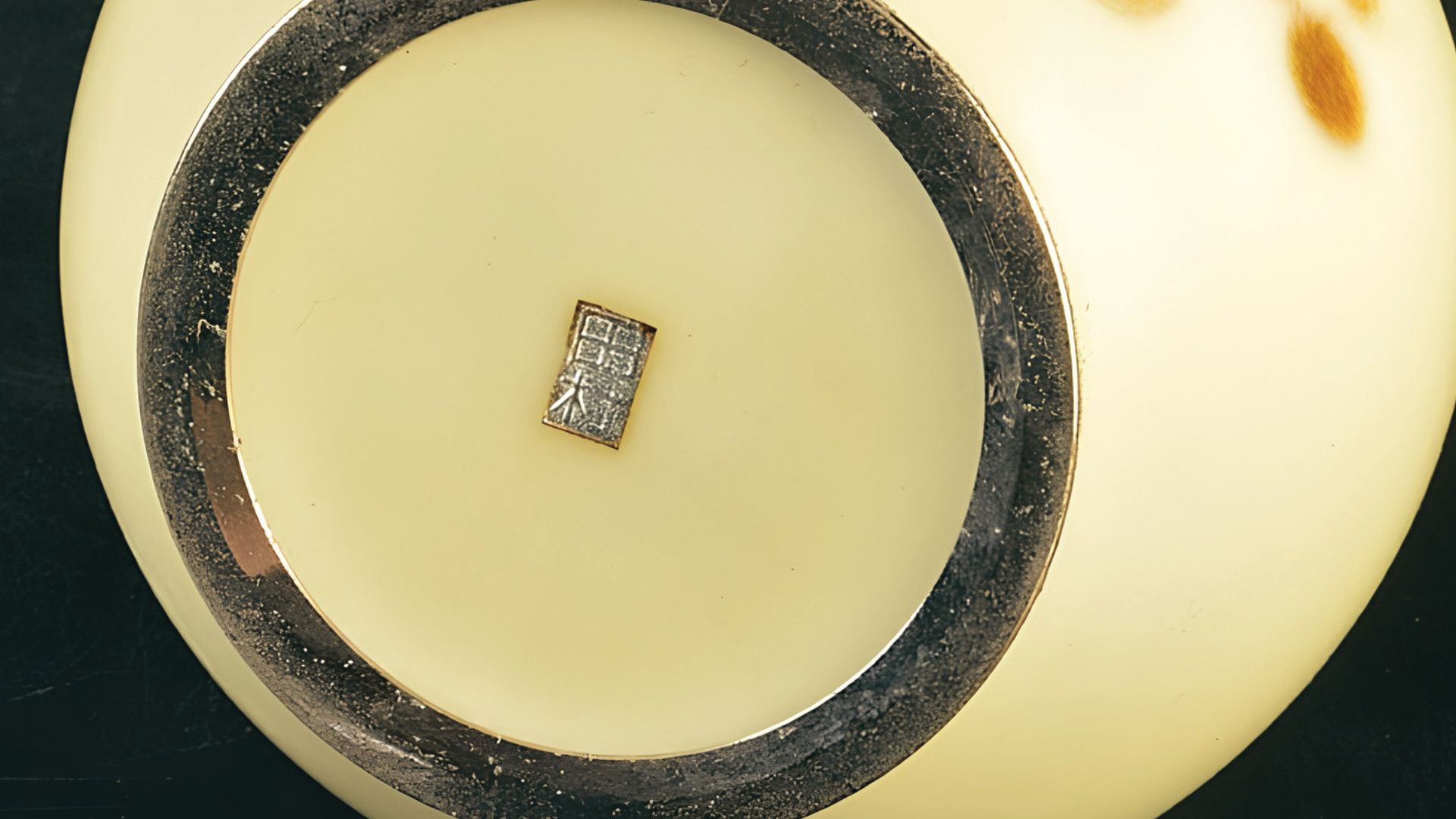
- On an inset metal tablet — a small silver or bronze plaque let into the base
- Stamped or impressed into exposed metal at the base or rim
- Engraved into the metal mount
One frequently repeated caution from the antiques trade is that a mark crudely scratched into a surface, rather than integrated into the construction, warrants extra scrutiny.
Workshop Marks on Antique Japanese Cloisonné
A small number of workshop marks are encountered regularly.
The Meiji masters
- Namikawa Yasuyuki (1845–1927), Kyoto — wired work of exceptional fineness. Appointed an Imperial Household Artist
- Namikawa Sōsuke (1847–1910), Tokyo — developed wireless enamel. Also an Imperial Household Artist
- Hayashi Kodenji, Nagoya — a major Nagoya workshop of the late Meiji period
- Kawade Shibatarō (1856–1921) — a leading technical figure associated with the Andō workshop
Because these names carry very high market value, they are also the names most likely to be attached to pieces that do not warrant them. Attribution to a named Meiji master should be treated as a claim requiring specialist verification, not as a description.
Import and Occupation Marks on Antique Japanese Cloisonné
These marks are about trade regulation and are useful for dating.
Country-of-origin marks
United States tariff legislation from 1891 required imported goods to be marked with their country of origin, and from the early 1920s US customs required the English name “Japan” rather than “Nippon”.
This gives a rough dating tool for pieces that entered the American market. Its limits should be understood clearly: it applies to goods imported into the United States, it does not apply to pieces that stayed in Japan or went elsewhere, and many marks were on paper labels that have since been removed.
Occupation-era marks
“Made in Occupied Japan” indicates production during the Allied occupation, 1945–1952, which is a narrow and therefore useful date range.
Marks reading CPO, for Central Purchasing Office, relate to goods sold to Allied forces during the same period and sometimes appear alongside the occupation marking.
This period matters for cloisonné specifically. After 1945, enamel proved a popular souvenir for occupation personnel returning home, because a metal-bodied object survived a long journey where wood, bamboo and paper did not — so a substantial quantity of cloisonné dates from these years.
Marks That Are Not Maker Marks
Several commonly misread markings.
- Auspicious characters. Characters such as 福, meaning good fortune, appear on early twentieth-century Japanese cloisonné as decoration rather than identification
- Silver purity marks. Many pieces have silver rims and mounts carrying their own marks, which describe the mount rather than the enamel work
- Retailer marks. Some pieces carry the mark of the shop or exporter rather than the workshop
- Later additions. Marks can be added after the fact
A silver mark on the rim is one of the most frequently misinterpreted features, because it looks official and is genuinely informative — just not about who made the enamel.
Assessing Antique Japanese Cloisonné Without Marks
Since most pieces are unmarked, this is the more useful skill.
What to examine
- Wire quality. Fine, even wire following curves cleanly indicates careful work. Thick, coarse or irregular wire indicates the opposite
- Surface level. View across the surface at a low angle. Well-built work sits level with the wires rather than dipping between them
- The metal. Exposed metal at rim and foot should show wear and oxidation consistent with the claimed age
- Weight and gauge. Thin, light bodies with flimsy foot rims are generally associated with later mass-market production
- Form. Assess the silhouette before the decoration; proportion is often where later copies diverge
Two honest limitations
First, none of these indicators is conclusive on its own. They are weighed together, alongside provenance where it exists.
Second, surface pitting is often cited as an age indicator, but it is not reliable in isolation. Pitting relates to enamel composition and firing conditions as much as to age, and it can also be reproduced. Use it as one factor among several.
Practical Advice on Antique Japanese Cloisonné Marks
A working sequence
- Photograph the base and any mark clearly under good light, including the mark’s physical form and how it was applied
- Establish the category — maker, import, occupation, auspicious character, or silver mount mark
- Assess the object independently of the mark, using construction and workmanship
- Check whether the two agree. A prestigious mark on modest workmanship is a reason for caution, not excitement
- Get specialist opinion before paying a specialist price
Where to look for reliable comparison
Museum collections are the most reliable reference points, because attributions there have been examined. Works by the major Meiji cloisonné makers are held in institutions including the Victoria and Albert Museum, the Walters Art Museum and the Ashmolean Museum, and in the Khalili Collection of Japanese Art. The former residence and workshop of Namikawa Yasuyuki in Kyoto is open to the public as a museum.
Auction house catalogues from established firms are the next most useful source, since attributions there carry commercial liability.
The realistic summary
Marks on antique Japanese cloisonné are a supporting piece of evidence rather than a primary identification tool. The object itself carries more reliable information than its base does.

TAMURA-SHIPPO 田村七宝工芸
Founded in Meiji 16 (1883). We are a kiln located in Shippo-cho, Ama City, Aichi Prefecture, specializing in “Owari Shippo,” a traditional craft designated by the Ministry of Economy, Trade and Industry. We continue to produce Shippo ware in order to preserve this beautiful traditional culture. The content of this article has been fully supervised by Tamura Shippo Kogei (with AI-generated summaries included), and has been proofread with reference to reliable books and government media sources.