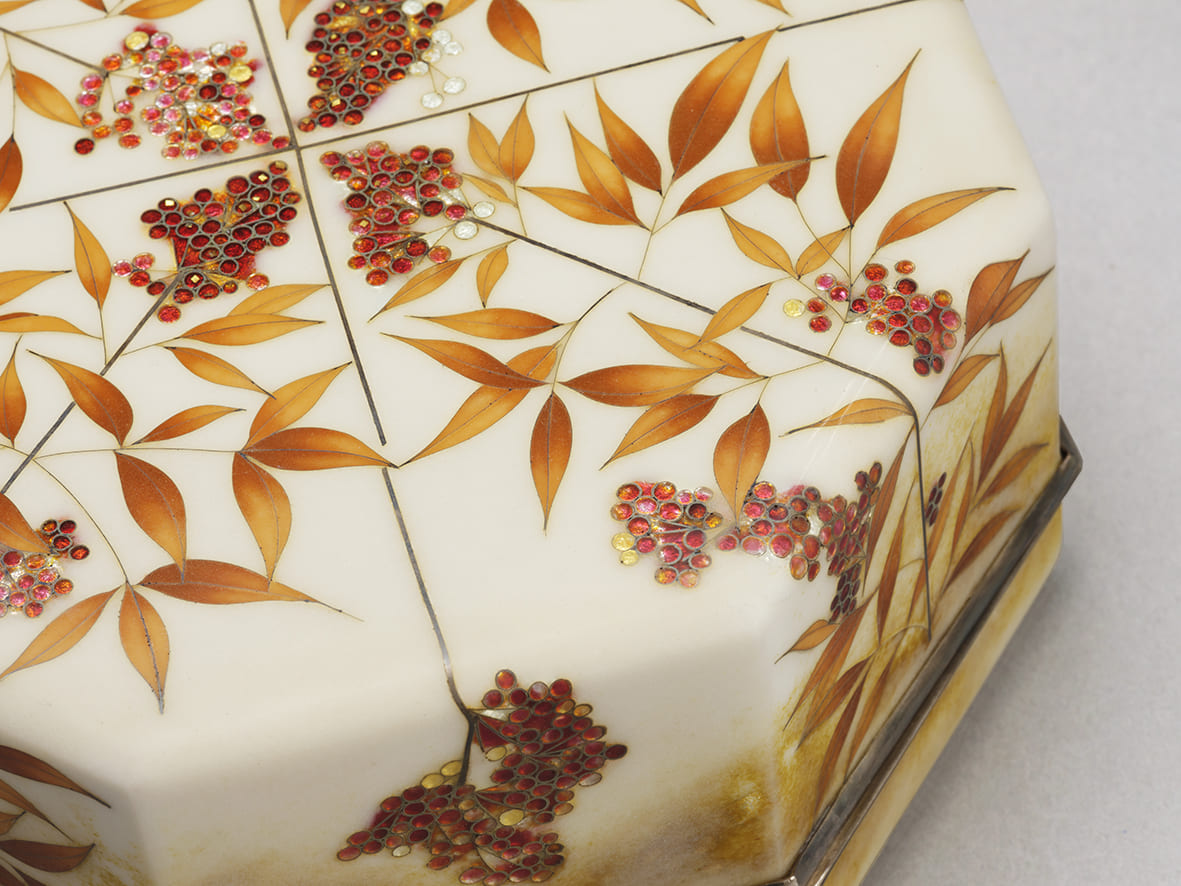
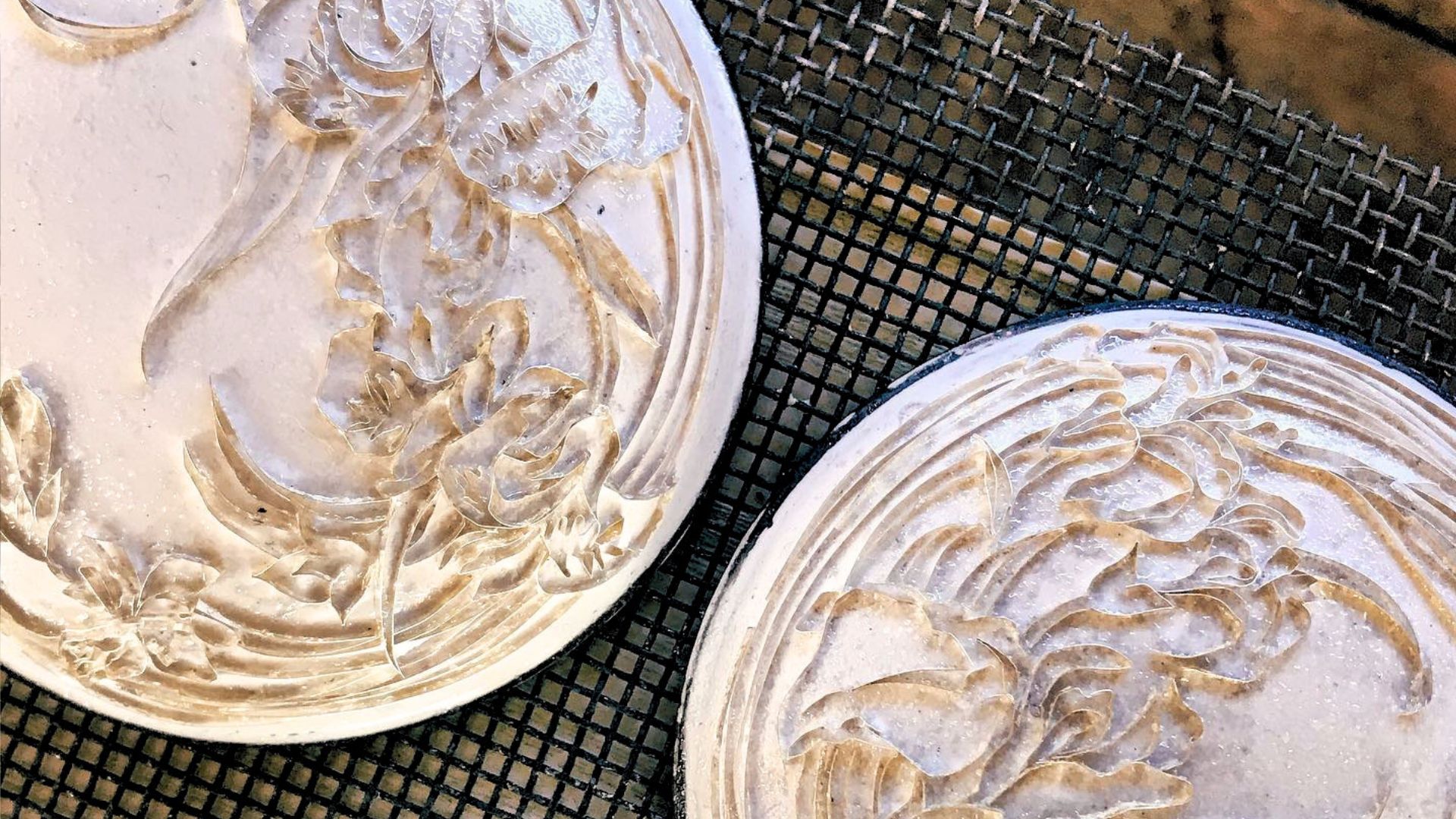
What Is Cloisonné? Meaning, Pronunciation, and How the Technique Works
Cloisonné is a word most people encounter before they encounter a definition — on a museum label, an auction listing, or the back of a piece of jewellery.
The meaning is more literal than it looks. The word is French, it means partitioned, and it describes exactly what the technique does to a surface before any colour is added.
This guide covers the meaning, the pronunciation, where the technique came from, and how to recognise it. We make cloisonné, so the explanation of the process is drawn from doing it.
What Is Cloisonné? The Meaning of the Word
Cloisonné means “partitioned” in French. It describes a decorative technique in which thin metal strips are fixed to a surface to form compartments, which are then filled with coloured enamel and fired.
The root is cloison, meaning a partition or dividing wall — the same word used in French for an interior wall in a building.
The definition in full
Cloisonné is metalwork in which vitreous enamel — powdered glass — is fused by firing into compartments formed by metal wire on a metal base.
Each element of that definition matters:
- Metal base — usually copper, silver or gold
- Metal wire — bent and fixed to form the outlines of the design
- Powdered glass — the colour, coloured by metal oxides
- Fired — heated until the glass melts and bonds to the metal
The compartments are the definition. Remove them and it is still enamel, but it is no longer cloisonné.
How to Pronounce Cloisonné
The word keeps its French pronunciation in English.
- British English: roughly “klwa-zon-AY”, with the stress on the final syllable
- American English: commonly “kloy-zuh-NAY”, with the first syllable anglicised
Both are in general use, and neither is treated as an error in English-speaking countries. The accent on the final e indicates that it is sounded rather than silent.
The Japanese and Chinese terms
- Japanese: shippō-yaki (七宝焼), pronounced roughly “ship-POH yah-kee.” Shippō means seven treasures; yaki means fired
- Chinese: jingtailan (景泰藍), “Jingtai blue,” named after the reign of the Jingtai Emperor (1450–1456), when the technique flourished under imperial patronage
The naming conventions differ revealingly: French names the structure, Chinese names a colour and a reign, and Japanese names an image of preciousness taken from Buddhist scripture.
What Cloisonné Looks Like
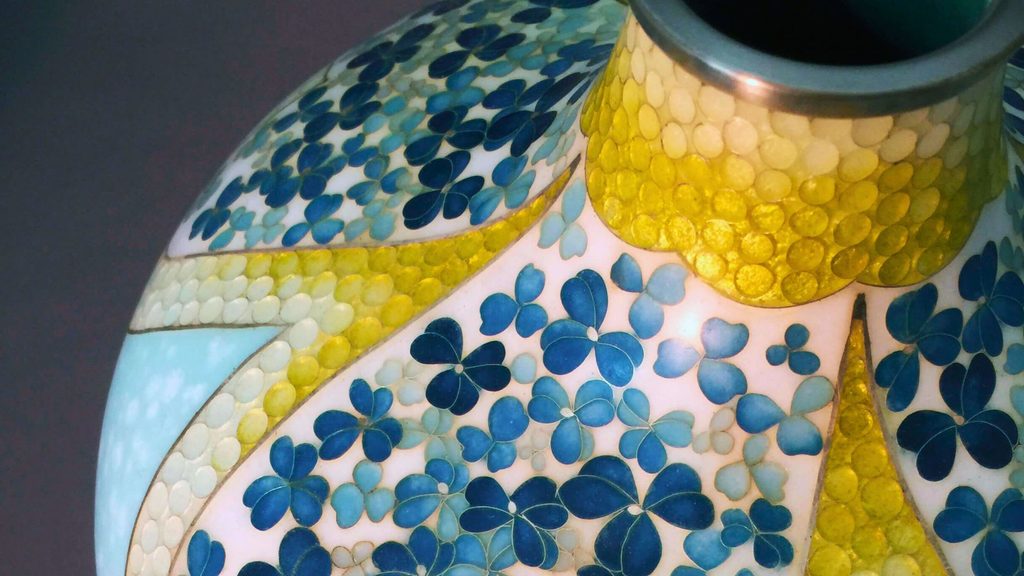
The technique has a recognisable signature.
The identifying features
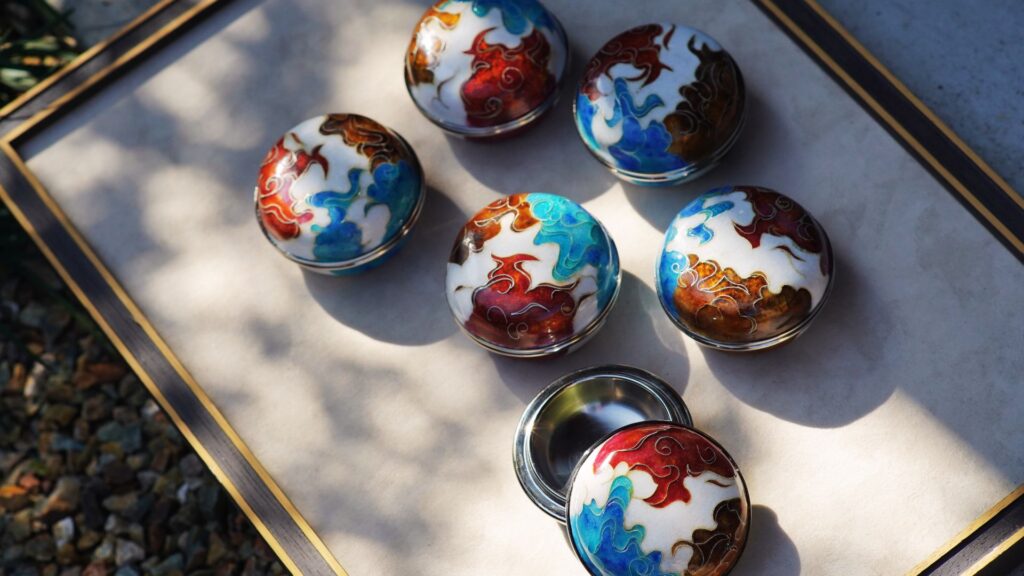
- Fine metal lines outlining every colour field, forming a continuous network across the design
- Flat, level colour within each compartment
- A hard, glassy surface that is cool to the touch
- Colour that can shift with the light, where transparent glaze has been used over metal
The simplest identification test: if thin metal lines separate every colour, and the surface is glass-hard, it is cloisonné.
What it is not
- Not painted metal. Paint sits on the surface and can be scratched with a fingernail; fired enamel cannot
- Not inlay of stone or shell. Those are set as solid pieces, not melted in place
- Not pottery. Despite the Japanese name ending in “fired,” the base is metal throughout
Where Cloisonné Came From
The technique is far older than the French word for it.
Ancient origins
Enamelling on metal appears in the ancient Near East and the eastern Mediterranean, with Egyptian examples including the inlaid decoration on the funerary mask of Tutankhamun. The basic idea — dividing a metal surface into cells and filling them with coloured material — is very old.
Byzantium and medieval Europe
Cloisonné enamel on gold was highly developed in the Byzantine world and used extensively for religious objects, and the technique was practised across medieval Europe alongside champlevé.
China
Cloisonné was established in China by around the fourteenth century and developed into a major imperial art form under the Ming dynasty (1368–1644). The technique reached a high point under the Jingtai Emperor, giving the Chinese name jingtailan.
Japan
Enamel objects existed in Japan from as early as the seventh century — the oldest confirmed example being fittings excavated in 1977 from the Kengoshizuka tomb in Nara Prefecture, dated to the late seventh century.
However, sustained production in the form recognised today began much later. In the Tenpō era (1830–1844), Kaji Tsunekichi (1803–1883) in Owari province worked out a method after studying an enamelled plate imported by a Dutch trading ship, and this became the basis of the modern Japanese industry.
How Cloisonné Is Made
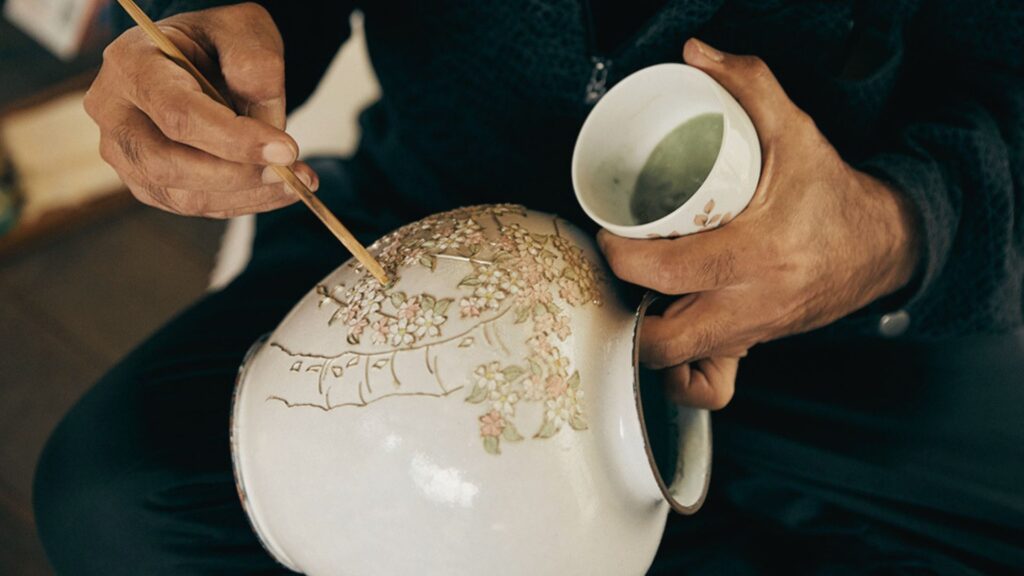
The sequence, as carried out in a working Japanese kiln.
- Form the base. Copper or silver is raised or spun into shape
- Draw the design directly onto the metal
- Set the wires. Flat ribbon wire is bent by hand and glued upright along every line
- Fire to fix the wires permanently to the body
- Apply the glaze. Powdered glass mixed to a paste is placed into each compartment, colour by colour
- Fire at around 800°C. The glass melts, then sinks as it cools
- Repeat glazing and firing until the surface stands level with the wires. The number of cycles depends on the piece
- Grind and polish by hand to the final surface
The firing temperature is set by the metal, not the glass. Copper melts at about 1,085°C, so the whole craft works in the band where glass flows and the base does not.
The repetition is not inefficiency: glaze contracts as it cools, so a single application always ends up below the level of the wires. Depth of colour is built rather than applied.
Types of Cloisonné and Related Techniques
| Technique | Description |
|---|---|
| Cloisonné | Wires added to the surface to form compartments |
| Champlevé | Cavities cut into the metal instead of wires added |
| Plique-à-jour | No backing, so light passes through |
| Basse-taille | Transparent enamel over an engraved metal surface |
| Painted enamel | Painted onto a fired ground, without compartments |
Japanese variants
- Yūsen shippō — wired; the standard technique of the Owari region
- Musen shippō — wireless; wires removed before final firing so colours blend. Developed by Namikawa Sōsuke (1847–1910)
- Shōtai shippō — the copper base dissolved away with acid, leaving translucent enamel
- Doro shippō — opaque glazes; the dominant Japanese style before transparent glazes came into use
Why Cloisonné Still Matters
Two properties account for its persistence over so many centuries and cultures.
The colour does not degrade
Because the colour is glass rather than pigment, it does not fade under light and cannot be rubbed away. This is why cloisonné was chosen for objects meant to last — reliquaries, imperial vessels, presentation pieces.
The technique cannot be faked at speed
Every outline in a wired piece has to be bent and placed individually before any colour is added, which is a constraint no shortcut removes. A mid-size vase can take weeks.
This makes the technique unusually legible to a buyer. Look at the tightest curve in the design, and look across the surface at a low angle. Those two observations tell you most of what you need to know about how carefully a piece was made.
Cloisonné is, in the end, a very simple idea executed with great patience: fence off a surface into small shapes, fill each with coloured glass, and fire it until the glass and the metal become one object.

TAMURA-SHIPPO 田村七宝工芸
Founded in Meiji 16 (1883). We are a kiln located in Shippo-cho, Ama City, Aichi Prefecture, specializing in “Owari Shippo,” a traditional craft designated by the Ministry of Economy, Trade and Industry. We continue to produce Shippo ware in order to preserve this beautiful traditional culture. The content of this article has been fully supervised by Tamura Shippo Kogei (with AI-generated summaries included), and has been proofread with reference to reliable books and government media sources.