Sakura Pattern Meaning: What the Cherry Blossom Represents in Japanese Culture
The cherry blossom is the most widely recognised Japanese motif internationally, and often the most flattened. Outside Japan it usually means “pretty, springlike, Japanese.”
In Japan it means something more specific: beauty that is valued partly because it does not last.
This guide covers what the sakura pattern means, where that meaning came from, how it behaves in design, and the twentieth-century history that gave the motif a second and more difficult reading.
Sakura Pattern Meaning: The Short Answer
- Transience — the central meaning; blossom lasts roughly a week
- Renewal and new beginnings — sakura coincides with the start of Japan’s school and business year in April
- Beauty and gentleness
- Spring — as a seasonal marker in formal design
Transience is not a sad footnote to the beauty; in the Japanese reading it is part of it. A flower that lasted three months would not carry the same meaning.
How it differs from Western flower symbolism
Western flower meanings usually attach to a quality: roses for love, lilies for purity. The sakura’s meaning attaches to a timeframe — the brevity of the bloom rather than a virtue the flower stands for.
Mono no Aware and the Deeper Sakura Pattern Meaning
Mono no aware (物の哀れ) describes a sensitivity to the transience of things and the gentle sadness that accompanies it.
Where the term comes from
The phrase received its influential formulation from the scholar Motoori Norinaga (1730–1801), who used it in his analysis of The Tale of Genji.
Norinaga was making an argument about Japanese literary character in an eighteenth-century intellectual context rather than simply recording an existing definition. The sensibility predates him; the crisp concept owes much to his writing.
Why sakura became its emblem
The bloom is spectacular, brief, and ends by falling rather than wilting — and the falling petals are themselves a celebrated sight with their own vocabulary in Japanese.
The moment most associated with the flower in Japanese aesthetics is the scattering rather than full bloom, which is a fair summary of the whole idea.
Where the Sakura Pattern Meaning Comes From Historically
Nara and Heian periods
In the Nara period the flower of poetic reference was the plum (ume), imported along with much else from China. Over the Heian period the cherry displaced it, and by the time of the classical poetry anthologies “the flowers” without qualification meant cherry blossom.
The Edo period
Cherry viewing spread beyond the aristocracy, supported by extensive planting in and around Edo. Many familiar varieties were developed in this period through cultivation.
The Somei-yoshino question
The variety dominating Japan’s cherry landscape today, Somei-yoshino, was developed in the late Edo or early Meiji period and propagated by grafting, meaning the trees are effectively clones.
This has a visible consequence: trees of this variety in a given area bloom and fall almost simultaneously. The synchronised intensity of modern hanami is therefore partly a product of nineteenth-century horticulture, not only of older sensibility.
The Sakura Pattern in Japanese Design and Craft
The main variants
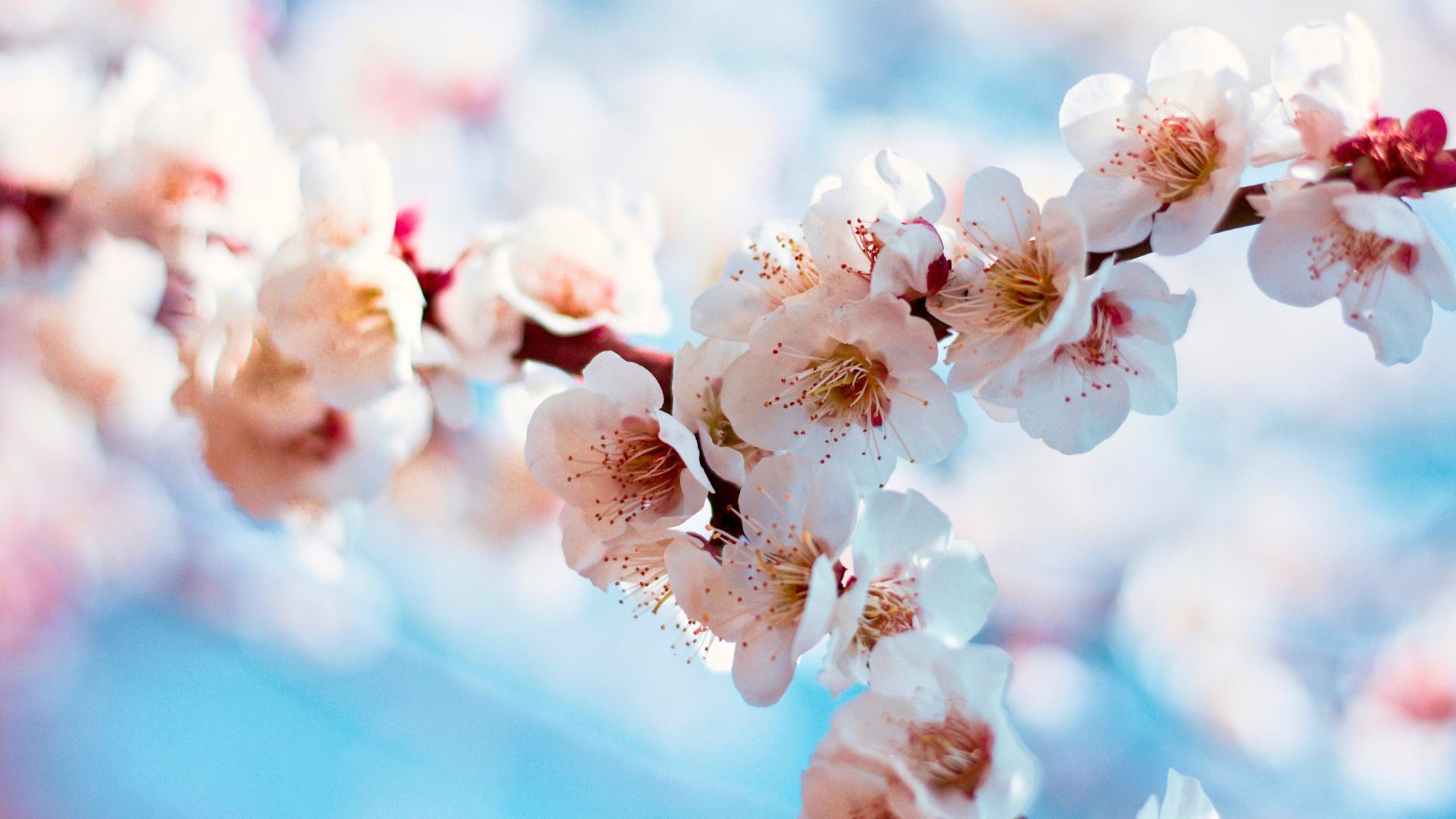
- Sakura — the flower shown whole, five rounded petals with a notch at each tip
- Chirizakura — falling or scattered petals, emphasising transience
- Sakura fubuki — “cherry blossom blizzard,” petals dense in the air
- Hanaikada — “flower raft,” fallen petals floating together on water
- Edazakura — blossoms on the branch, a more formal treatment
The distinction between whole-blossom and scattering patterns is real in Japanese design: the first reads as spring and celebration, the second invokes impermanence more strongly.
Identifying the flower correctly
Sakura and ume are frequently confused in non-Japanese design. The reliable difference is the petal tip: cherry petals have a small notch at the end, plum petals are rounded without one. Plum blossoms also sit directly against the branch, while cherry blossoms are held out on stems.
Hanami: Sakura Meaning in Practice
What hanami is
Hanami (花見), “flower viewing,” means gathering under cherry trees in bloom, typically with food and drink. It is a mass social event rather than a contemplative one, with parks crowded from morning until night.
The timing
The blossom front moves northward across Japan over roughly two months, reaching the southwest first and Hokkaidō last. Bloom forecasts are issued and followed closely, because the window in any one place is short.
That urgency is the meaning in operational form: hanami has to be arranged quickly and cannot be rescheduled.
Yozakura
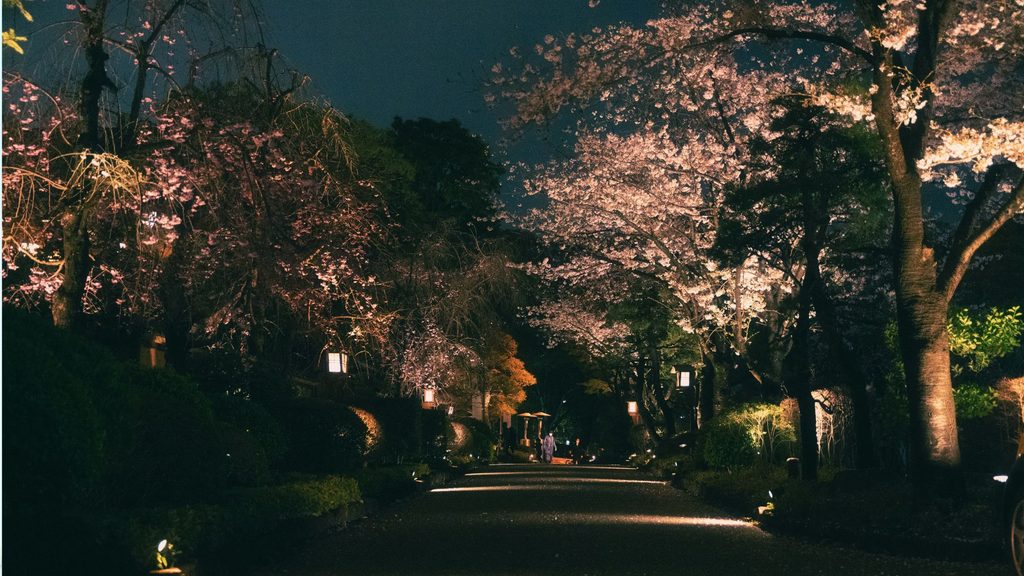
Evening viewing of illuminated trees, yozakura, is a distinct tradition with a different atmosphere from daytime gatherings.
The Difficult Side of Sakura Pattern Meaning
Wartime use of the motif
During Japan’s imperial and wartime period, the cherry blossom was used in state and military symbolism, with the falling blossom invoked as an image for soldiers dying young for the nation. The motif appeared in military iconography, and the flower’s association with beautiful early death was drawn on deliberately in wartime rhetoric.
The word sakura also appears in the naming of certain wartime weapons and units.
What this means for the motif today
This history has not made the cherry blossom taboo in Japan. It remains overwhelmingly a symbol of spring, renewal and gentle beauty, used constantly in ordinary commercial and personal contexts.
The association exists and is discussed by Japanese scholars, and it is part of why the motif carries more weight in Japan than “pretty pink flower” suggests.
Using the Sakura Pattern Meaning Correctly
Seasonality
In formal Japanese dress, sakura is a spring motif, and wearing it well outside the season reads as careless. A conventional guideline is to wear it slightly ahead of the actual bloom rather than after it.
This applies to kimono and formal textiles. It does not apply to jewellery, tableware, stationery or decorative objects, which are used year-round without comment.
Good occasions for a sakura gift
- Graduations and new job starts — the April timing makes this natural
- Spring celebrations
- Gifts marking a beginning or a transition
How to describe it accurately
The accurate short description is beauty inseparable from its own brevity — not simply “spring” and not simply “beauty.”
That reading is what makes the motif interesting rather than merely decorative, and it survives translation better than most Japanese aesthetic ideas.

TAMURA-SHIPPO 田村七宝工芸
Founded in Meiji 16 (1883). We are a kiln located in Shippo-cho, Ama City, Aichi Prefecture, specializing in “Owari Shippo,” a traditional craft designated by the Ministry of Economy, Trade and Industry. We continue to produce Shippo ware in order to preserve this beautiful traditional culture. The content of this article has been fully supervised by Tamura Shippo Kogei (with AI-generated summaries included), and has been proofread with reference to reliable books and government media sources.