Shippo-Yaki: The Japanese Enamel Craft Named After the Seven Buddhist Treasures
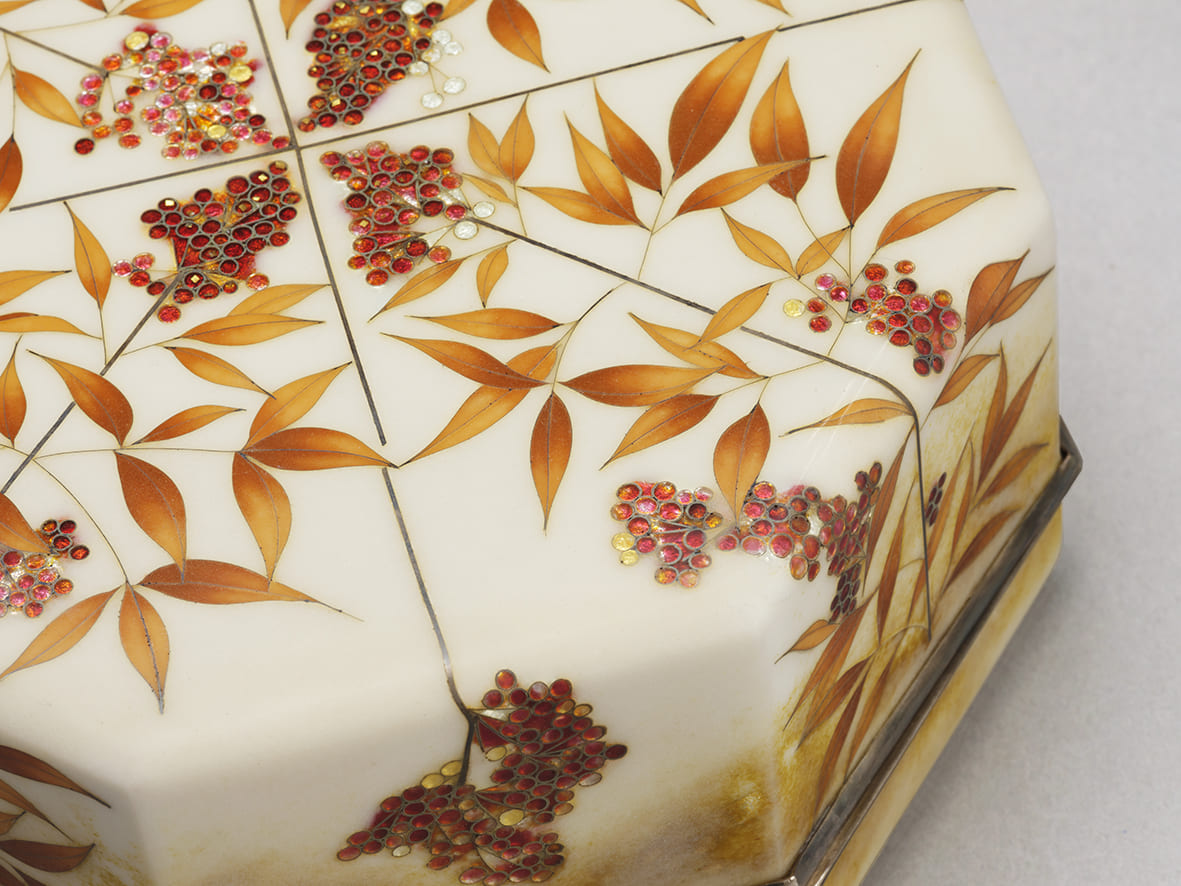
Shippo-yaki is the Japanese name for what English speakers usually call Japanese cloisonné. The Japanese word carries information the English one does not.
“Shippo” means seven treasures. “Yaki” means fired. The name is a comparison: glass fired onto metal until it recalls the seven precious substances described in Buddhist scripture.
This article explains what shippo-yaki is, how it is made stage by stage, and how to tell its main types apart. We have fired it in Shippō-chō, Aichi since 1883, so the process description is our daily work rather than a summary of other sources.
What Is Shippo-Yaki? A Plain Definition
Shippo-yaki (七宝焼) is a Japanese metal craft in which powdered glass glaze is fused onto a metal base — usually copper or silver — by firing at approximately 800°C.
The result is a hard, glass-surfaced object whose colour comes from the glass itself rather than from paint or coating.
The most common misconception
Because the name ends in yaki, “fired,” English speakers often assume shippo-yaki is a kind of pottery. It is not. Shippo-yaki is classified as metalwork, not ceramics — the base is metal from start to finish, and clay is not involved.
| Japanese pottery | Shippo-yaki | |
|---|---|---|
| Base material | Clay | Copper, silver, gold |
| Glaze | Mineral, fuses with the clay body | Powdered glass, sits on metal |
| Firing temperature | Roughly 1,100–1,300°C | Around 800°C |
| Firing pattern | Typically bisque then glost | Repeated firings, built up in layers |
| Craft category | Ceramics | Metalwork |
The temperature difference is not about difficulty but about physics: copper melts at about 1,085°C, so the craft has to operate in the band where glass flows but the metal does not.
Why Shippo-Yaki Is Named After Seven Treasures
The word shippō comes from Buddhist scripture, where it names precious substances used to convey the splendour of the Pure Land.
The seven treasures
- Gold
- Silver
- Lapis lazuli (ruri)
- Crystal (hari)
- Giant clam shell (shako)
- Coral
- Agate
The exact list varies between sutras — the Muryōju-kyō and the Lotus Sutra do not agree — because the intention was an image of abundance rather than a fixed inventory.
Two accounts of the craft’s name
Historical sources offer two explanations. One holds that the ware was named around the Momoyama period because it was as beautiful as the seven treasures named in scripture. The other holds that the name refers to the jewel-like mineral materials used in the glaze.
Neither has been settled, and they are not incompatible: a craft using mineral materials to produce jewel-like colour arrives at the same name from either direction.
It is worth noting how unusual the naming is. English calls the craft “enamel,” French “cloisonné,” Chinese “falang” — all descriptions of method or structure. The Japanese name instead reaches for an image of beauty, which tells you something about how the craft was regarded when it acquired the name.
How Old Is Shippo-Yaki? From a 7th-Century Tomb Onward
The technique did not originate in Japan. Enamelling appears in the ancient Near East — Egyptian examples include the blue inlay on the funerary mask of Tutankhamun — and travelled east along the Silk Road through China and Korea.
The oldest surviving Japanese example
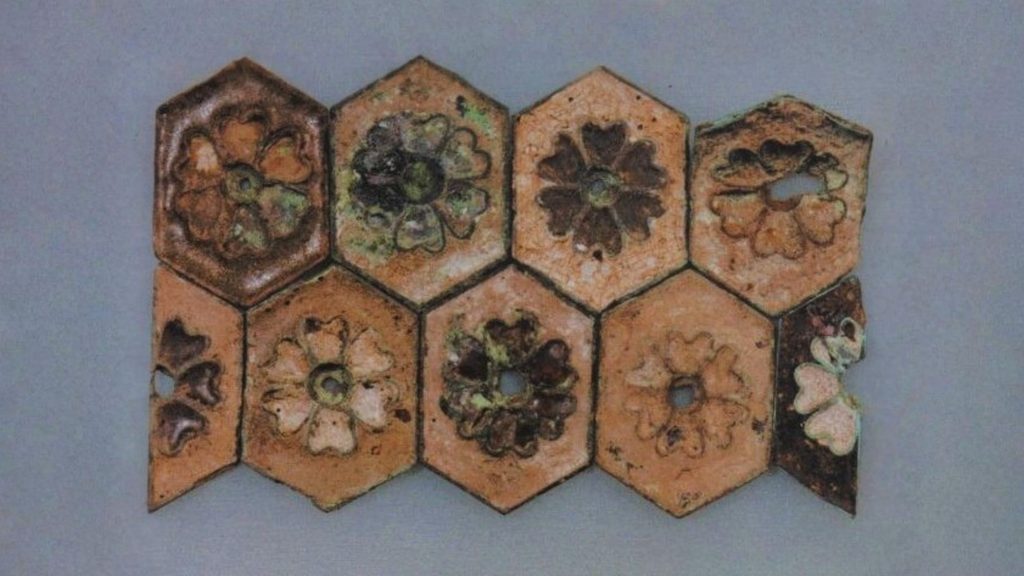
The oldest confirmed shippo object in Japan is a set of enamelled tortoise-shell-shaped fittings excavated from the Kengoshizuka tomb in Asuka, Nara Prefecture.
- Excavated in 1977 during the second survey of the site
- Found inside the burial coffin
- Copper, roughly 4.6 cm across
- Tomb dated to the late 7th century
That places enamel work in Japan at least 1,300 years ago, and the piece is notable for using transparent glaze. Some sources instead put gilt-bronze saddle fittings from the 6th-century Fujinoki tomb first — a disagreement that turns on where the definitional line for enamel is drawn.
The intervening centuries
- 8th century — an enamelled mirror preserved in the Shōsōin repository, Nara
- Heian period — enamelled door fittings at the Phoenix Hall of Byōdō-in
- 1634 — sliding-door pulls at Nagoya Castle’s Honmaru Palace, among the oldest domestically made shippo with a confirmed production date
For most of this history shippo was hardware and fittings — decoration attached to important things, rather than an independent art form.
Kaji Tsunekichi and the Birth of Modern Shippo-Yaki
Japan has more than one enamel lineage. Kyoto had its own from the early Edo period, with the metalworker Hirata Dōnin (1591–1646) serving the shogunate and the craftsman Kachō producing enamelled door pulls and nail covers for Katsura Imperial Villa and Daitoku-ji.
What Kaji Tsunekichi (1803–1883) began is specifically the Owari lineage, which became the mainstream of modern Japanese shippo — which is why he is known in Japan as the father of modern shippo, not as its inventor.
How he worked it out
Tsunekichi, from Owari province in what is now Aichi Prefecture, obtained an enamelled plate brought to Japan by a Dutch trading ship during the Tenpō era (1830–1844). No one in Japan at the time knew the method.
According to the accounts handed down, he studied the plate for years, and eventually broke the valuable imported object deliberately to examine its structure. That is how he identified the copper base, and worked out the sequence of forming a copper body, setting wires, and applying glaze.
An important qualification: what Tsunekichi established was the opaque style known as doro shippō. The transparent, luminous glazes now associated with Japanese enamel came from later research, not from him.
How the technique spread
Tsunekichi taught Hayashi Shōgorō of Tōshima village — now Shippō-chō in Ama City — reportedly under an agreement that the method pass to a single heir only. Despite that restriction the technique took root in the district and grew into a regional industry, which is how a town in Aichi came to be named “Shippō.”
Later makers pushed the craft further. Namikawa Yasuyuki (1845–1927) in Kyoto refined wired work; Namikawa Sōsuke (1847–1910) in Tokyo developed wireless enamel. Both were appointed Imperial Household Artists. Japanese enamel was shown at the Paris Exposition of 1867, and by the Exposition of 1900 it was drawing high international praise.
How Shippo-Yaki Is Made, Stage by Stage
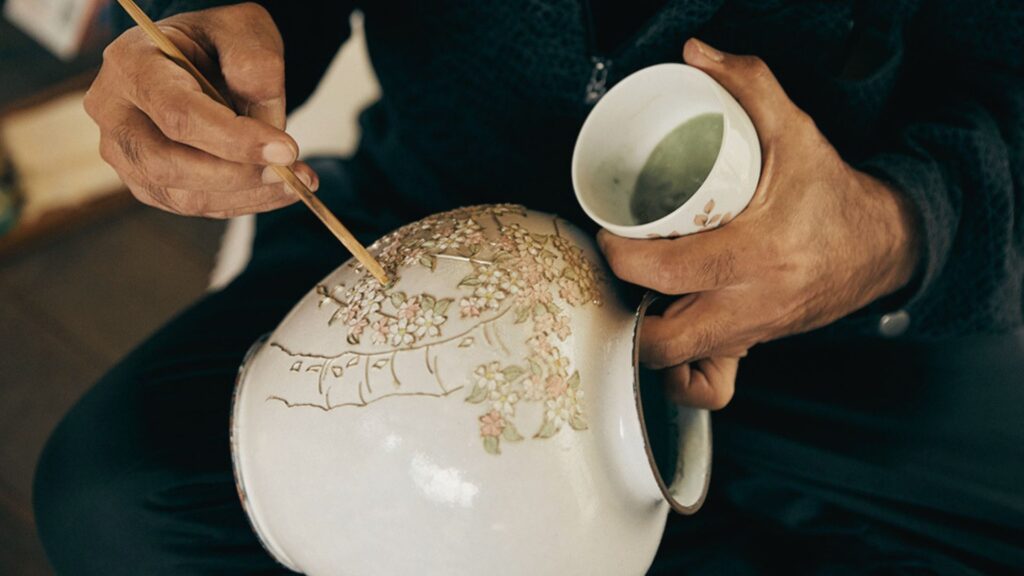
This is our own workshop sequence.
- Forming the base. A copper or silver sheet is raised or spun into a vase, plate, or pendant blank.
- Drawing the design. The pattern is drawn directly onto the metal in sumi ink.
- Wire setting (shokusen). Flat silver ribbon wire is bent by hand and glued upright along every line of the design. This stage largely shapes the character of the finished piece, because every subsequent colour is confined by these lines.
- Fixing the wires. A firing sets the wires permanently onto the body.
- Applying glaze. Powdered glass, mixed to a paste, is placed into each wired cell with a fine spatula, colour by colour.
- Firing. Roughly 800°C. The glaze melts, then sinks as it cools.
- Building up. Because the glaze contracts on cooling, glazing and firing are repeated until the surface stands level with the wires. How many times depends entirely on the piece — its size, its colours, the depth being aimed for. There is no set number.
- Polishing and finishing. The piece is ground flat with whetstones and polished by hand to its final surface.
The repetition is not inefficiency. It is how depth of colour is built, and it is why a mid-size vase can take weeks.
Two stages show a maker’s skill most clearly to a buyer: wire setting and final polishing. Look at the tightest curve in the design, then look across the surface at a low angle to judge how flat it truly is.
The Main Types of Shippo-Yaki and How to Tell Them Apart
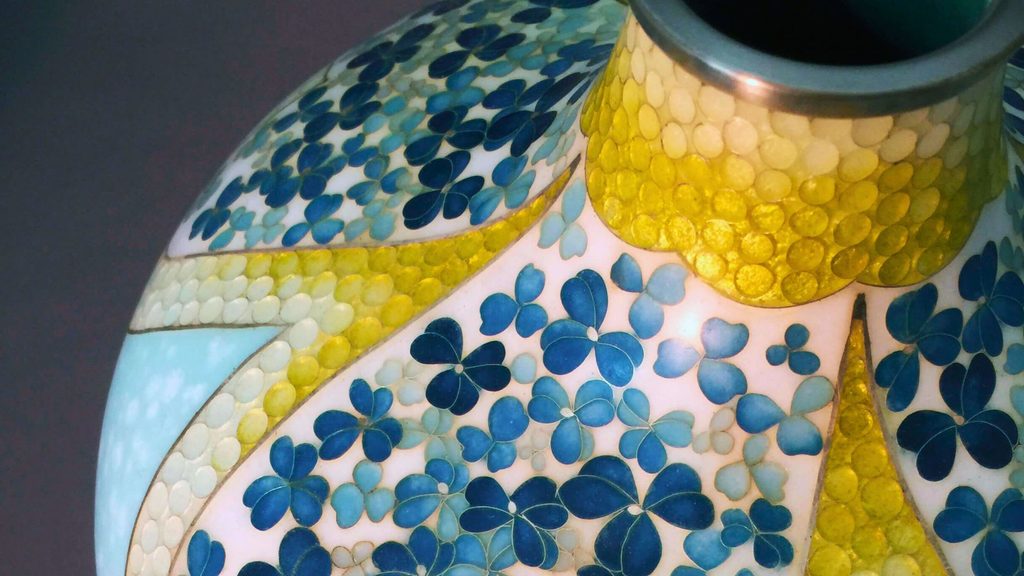
Types divide along two axes: what the base is, and whether wires remain visible.
By wire
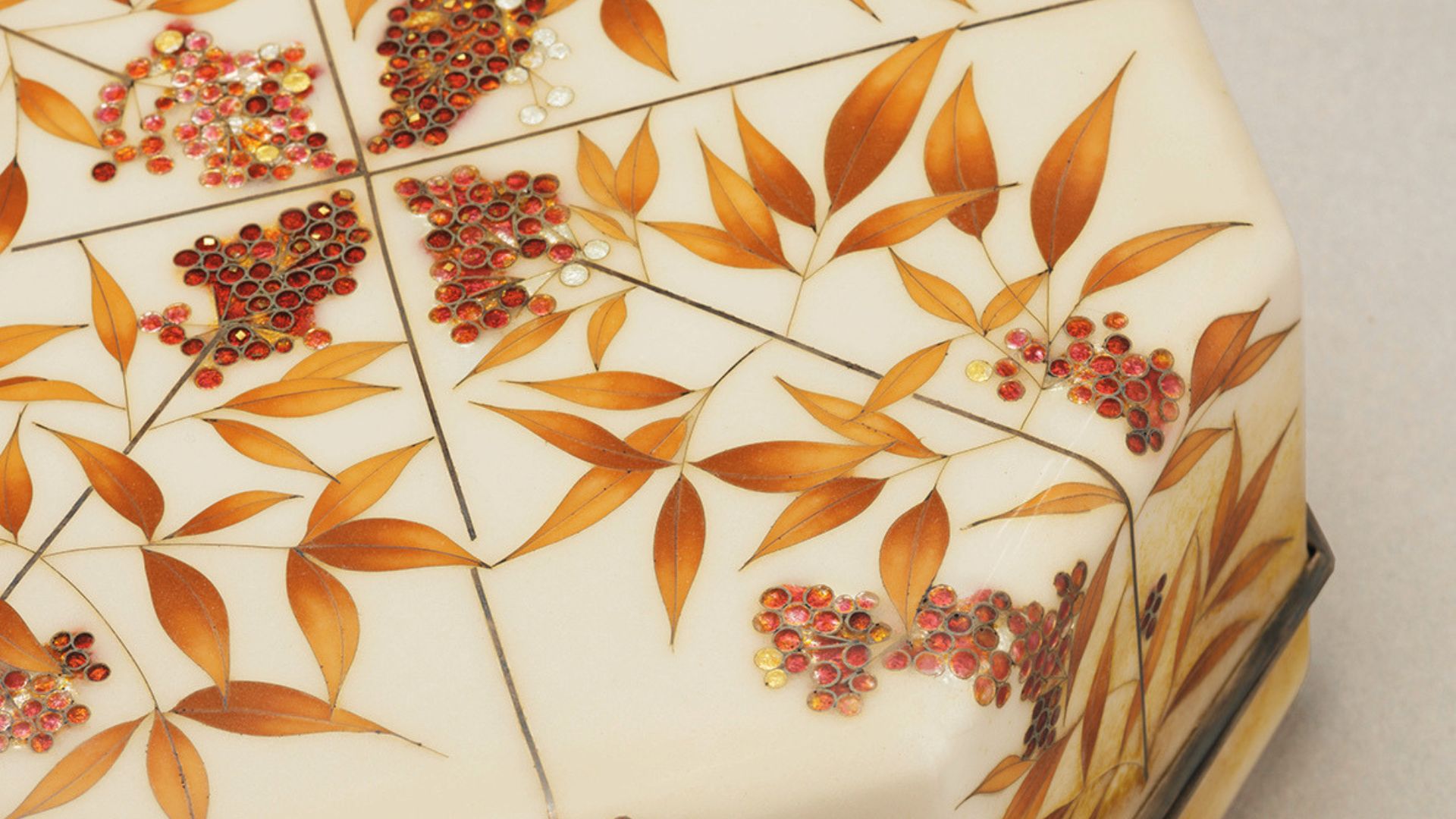
- Yūsen shippō (wired) — silver wires remain in the finished piece as outlines. The representative technique of Owari shippō, and the counterpart of French cloisonné.
- Musen shippō (wireless) — wires are removed before final firing, so colours blend. Developed by Namikawa Sōsuke to achieve effects closer to Japanese ink painting.
By base
- Kinzokutai — standard metal base
- Shōtai shippō — the copper base is dissolved away with acid after firing, leaving translucent enamel. Comparable to plique-à-jour; beautiful and very fragile
- Tōtai shippō — parts of the base are pierced and filled with transparent glaze
- Doro shippō — opaque glazes; the dominant Japanese style before transparent glazes came into use
A quick identification test: fine metal lines outlining every colour means wired; colours melting into one another means wireless; light passing through means the base has been removed.
Transparent glaze deserves its own note. Before the Meiji period Japanese enamel was largely opaque doro shippō. The development of high-clarity transparent glaze — work in which the German scientist Gottfried Wagener (1830–1892) played a part — is what made the luminous depth of Meiji-era shippo-yaki possible.
Where Shippo-Yaki Is Made Today: Owari Shippo in Aichi
The mainstream of Japanese shippo-yaki is Owari shippō, produced in Ama City and Nagoya City, Aichi Prefecture.
National designation
Owari shippō was designated a national Traditional Craft Product on 5 April 1995, in the 29th round of designations. The official listing specifies a copper or silver base and glass glaze, with motifs of flowers, birds and landscape, and identifies wired shippō as the region’s representative technique. It is also registered as a regional collective trademark.
Source: Aichi Prefecture, Traditional Crafts of Aichi — Owari Shippō.
The town called Shippō
Shippō-chō in Ama City takes its name from the craft — an industry naming its own geography rather than the reverse. The area’s historical district, Kaitō-gun, is where Tsunekichi’s method took hold through his student Hayashi Shōgorō.
The scale of the industry, honestly stated
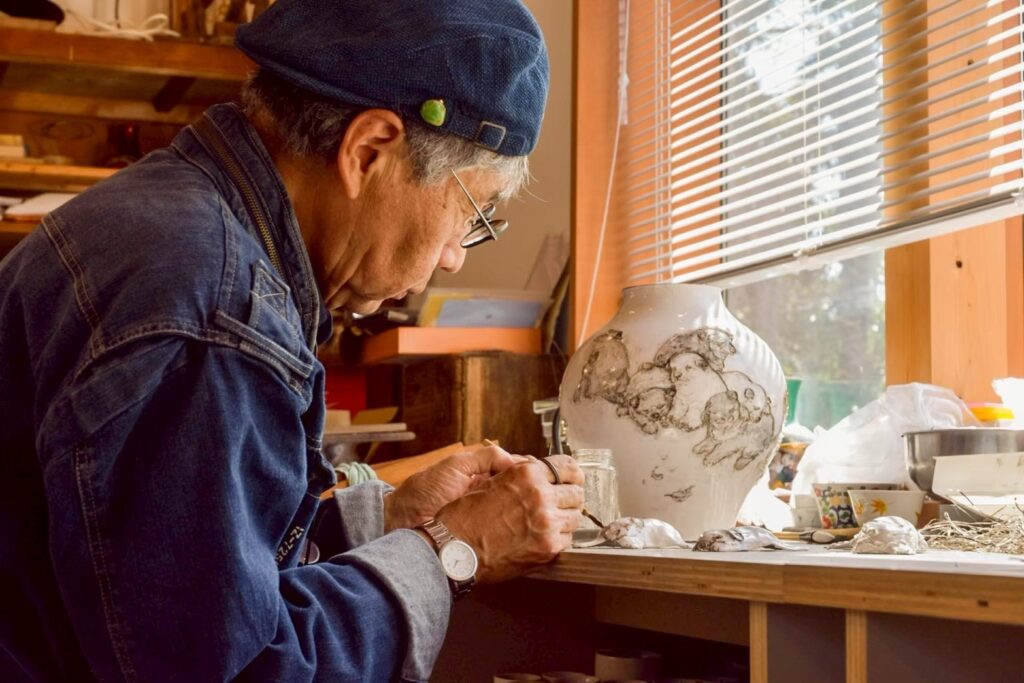
This is a small industry. As of May 2017 the Shippō-chō producers’ cooperative had eight member businesses and the Nagoya cooperative seven.
Its survival was not smooth. Wartime restrictions classified the craft’s core materials — copper, lead oxide, cobalt, manganese — as military supplies, and production became extremely difficult. After 1945 demand returned from an unexpected direction: enamel made an ideal souvenir for occupation personnel returning home, because a metal-bodied object survived the journey where wood, bamboo and paper did not.
The peak of the export era is still visible in the region. A large vase of 1.52 metres, made in the 1890s and displayed in Shippō-chō, is among the largest shippo-yaki pieces ever produced.
Our own workshop was founded in Shippō-chō in 1883 and has worked the same technique in the same district across five generations. The reason to mention that is not lineage for its own sake — it is that in a craft made by chains of specialists, continuity in one place is what keeps a technique executable at all.
Source: Aichi Prefecture; Japan Traditional Crafts Aoyama Square.

TAMURA-SHIPPO 田村七宝工芸
Founded in Meiji 16 (1883). We are a kiln located in Shippo-cho, Ama City, Aichi Prefecture, specializing in “Owari Shippo,” a traditional craft designated by the Ministry of Economy, Trade and Industry. We continue to produce Shippo ware in order to preserve this beautiful traditional culture. The content of this article has been fully supervised by Tamura Shippo Kogei (with AI-generated summaries included), and has been proofread with reference to reliable books and government media sources.