Chinese vs Japanese Cloisonné: The Real Differences and How Collectors Tell Them Apart
Chinese and Japanese cloisonné share a technique and diverge in almost everything else: when they developed, who they were made for, what they depict, and how they were finished.
Distinguishing them is a routine question in the antiques trade, and the answers circulating online are a mixture of solid history and dealer rules of thumb, presented with equal confidence.
This guide separates the two. Historical facts are stated as facts; identification heuristics are labelled as heuristics, because that is what they are.
Chinese vs Japanese Cloisonné: The Historical Difference
The most reliable distinction is chronological.
China
Cloisonné was established in China by around the fourteenth century and became a major imperial art form under the Ming dynasty (1368–1644). It was produced within imperial workshop systems, often tied to the court, for temples, palaces and ceremonial use.
The Chinese name jingtailan (景泰藍), “Jingtai blue,” derives from the reign of the Jingtai Emperor (1450–1456), a period strongly associated with the technique — although Ming examples predating that reign exist.
Japan
Enamel objects existed in Japan from as early as the seventh century, but sustained production in the form now recognised began in the nineteenth century.
In the Tenpō era (1830–1844), Kaji Tsunekichi (1803–1883) in Owari province worked out a method after studying an enamelled plate brought by a Dutch trading ship. Japanese cloisonné then developed rapidly during the Meiji period (1868–1912), driven substantially by export demand and by international expositions.
The practical consequence: Chinese cloisonné has roughly five centuries of production behind it, while the bulk of collectable Japanese cloisonné was made within a span of about seventy years.
Chinese vs Japanese Cloisonné: Who They Were Made For
The intended audience shaped both traditions more than the technique did.
| Chinese | Japanese (Meiji) | |
|---|---|---|
| Principal patron | The imperial court and religious institutions | Export market and presentation gifts |
| Function | Ceremonial and architectural vessels, temple objects | Display pieces, vases, exhibition works |
| Scale | Includes very large ceremonial objects | Concentrated in vessel and display scale |
| Development pressure | Continuity within an imperial tradition | International competition at expositions |
Japanese cloisonné developed in an environment of exhibition competition, where technical novelty was directly rewarded, which is a large part of why techniques such as wireless enamel emerged when they did.
Chinese cloisonné developed inside an imperial system with different priorities, where consistency with an established visual language mattered more than technical innovation. Neither context is superior; they produced different things because they asked for different things.
Chinese vs Japanese Cloisonné: Design and Subject Matter
Subject matter is one of the more reliable indicators, though not an absolute one.
Chinese motifs
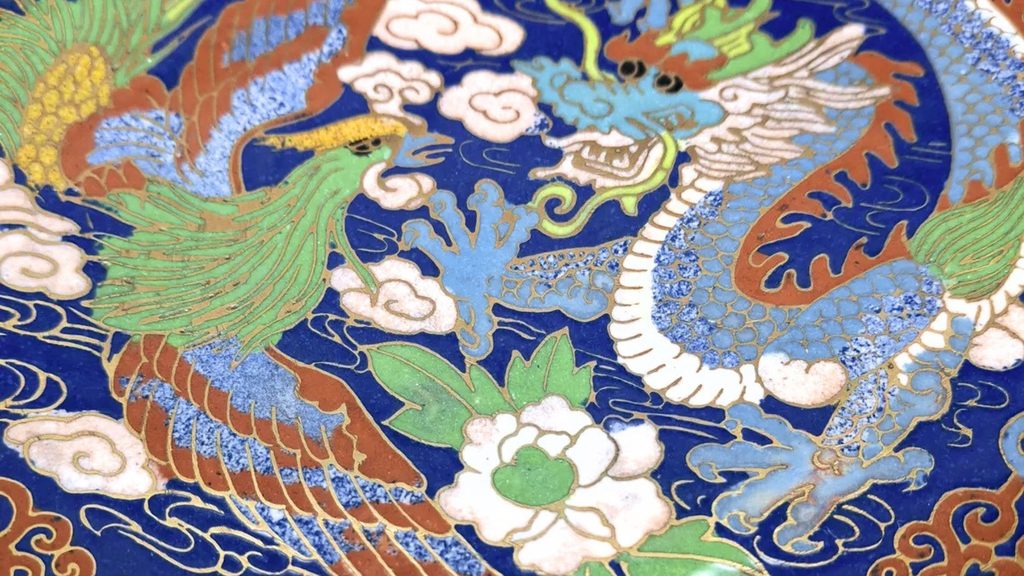
- Dragons and phoenixes
- Lotus scrolls and cloud patterns
- Symmetrical, repeating formal arrangements
- Auspicious symbols drawn from Buddhist and Daoist iconography
- Ruyi-head borders at rims
Japanese motifs
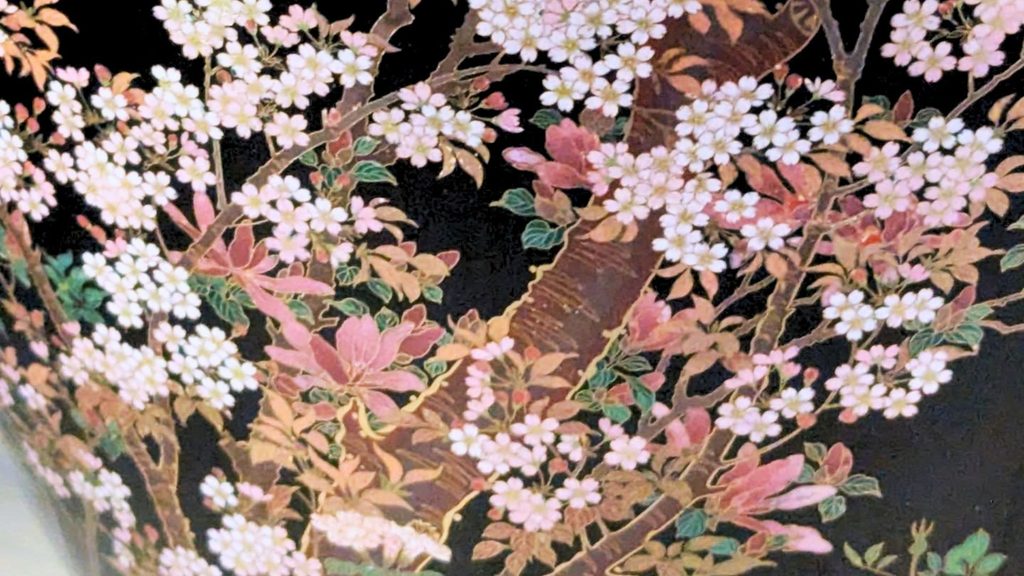
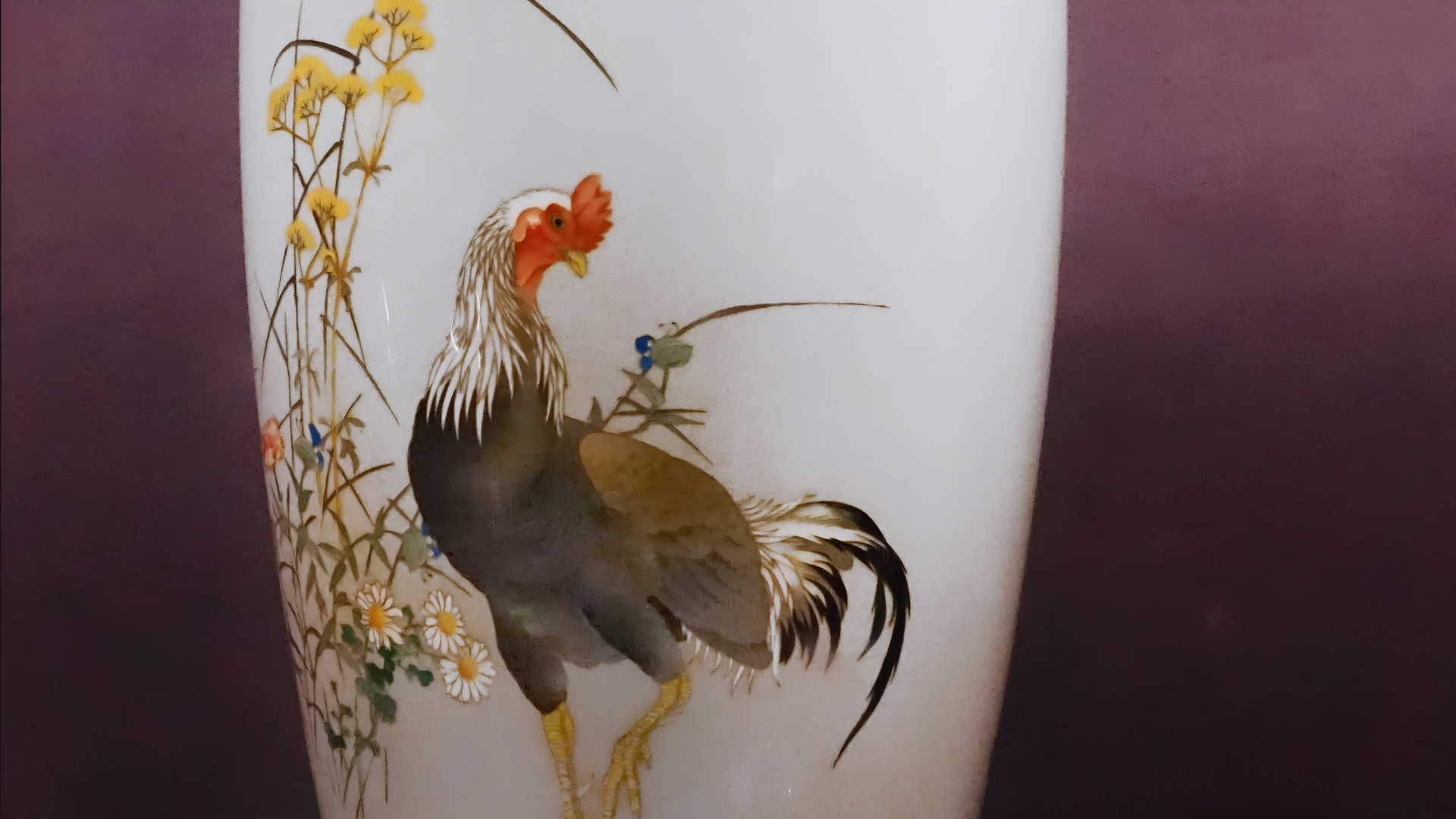
- Birds on flowering branches
- Seasonal flowers, insects, landscapes
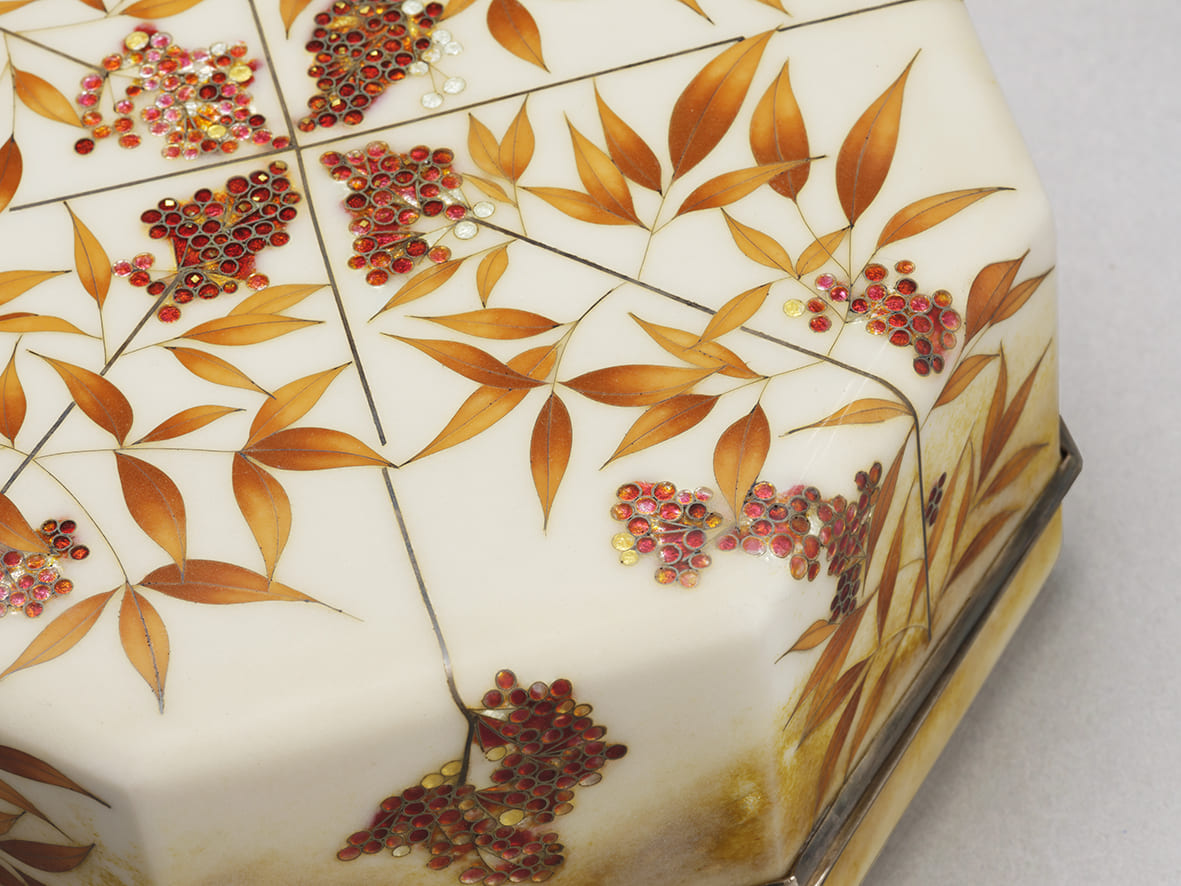
- Asymmetric composition with areas of plain ground
- Panels or windows set within a plain field
The structural difference worth internalising: Chinese designs typically fill the surface with pattern, while Japanese Meiji designs often leave substantial areas of unbroken colour.
This has a technical dimension. Wires were historically used across the background partly to stop molten enamel from running during firing, so large areas of clear, undivided colour represent a technical achievement rather than merely a stylistic preference.
Chinese vs Japanese Cloisonné: Construction Details Collectors Use
These are the heuristics used in the trade. They are pattern recognition built from handling many pieces, not rules — each has exceptions, and published sources sometimes contradict each other.
| Feature | Often Chinese | Often Japanese |
|---|---|---|
| Wire | Thicker, uniform gauge throughout | Finer, with variation in gauge and metal |
| Interior | Frequently unenamelled | Frequently enamelled, often a plain colour |
| Rim borders | Ruyi-head or scrolling patterns | Plain narrow bands |
| Surface | May show pitting from firing | Often ground and polished to a smooth finish |
| Weight | Often heavier for the size | Often lighter |
| Gilding | Exposed metal frequently gilded | Many export pieces ungilded |
How to use this table honestly
No single row is decisive. Several rows pointing the same way is meaningful; one row on its own is not.
Two specific cautions:
Pitting is unreliable as an origin or age indicator. It relates to enamel composition and firing conditions as much as to where or when a piece was made, and it can be reproduced deliberately.
Interior enamelling is a widely cited heuristic but should not be treated as a rule. Practice varies by workshop, period and object type in both countries.
Chinese vs Japanese Cloisonné: Technique Vocabulary
Some techniques are associated with one tradition specifically.
Techniques developed in Japan
- Musen shippō (wireless) — wires removed before final firing so colours blend. Developed by Namikawa Sōsuke (1847–1910)
- Shōtai shippō — the copper base dissolved away, leaving translucent enamel
- Ginbari — transparent glaze over textured silver foil
What this means for identification
A wireless piece with blended, painterly colour transitions is a strong indicator of Japanese origin, because the technique was developed there and is closely associated with the Meiji period.
The reverse inference does not hold: a wired piece could be from either tradition, since wired work is the common ancestor of both.
Chinese vs Japanese Cloisonné: Value and the Market
An area where a great deal of confident nonsense circulates.
What determines value
- Quality of execution — fineness of wire, evenness of surface, precision at difficult points
- Period — imperial-era Chinese and Meiji Japanese pieces command more than later production
- Attribution — a documented workshop or maker
- Condition — chips and hairline cracks in the glass layer matter considerably
- Provenance
Neither tradition is universally more valuable than the other. Exceptional pieces from either can reach very high prices, and the large majority of cloisonné in circulation from both countries is modest twentieth-century production worth modest sums.
A note on twentieth-century volume
Both countries produced cloisonné in quantity for the tourist and export market through the twentieth century, and this material makes up most of what is encountered. Distinguishing a good Meiji piece from a 1960s tourist piece is a more consequential question for most buyers than distinguishing Chinese from Japanese.
A Practical Sequence for Telling Them Apart
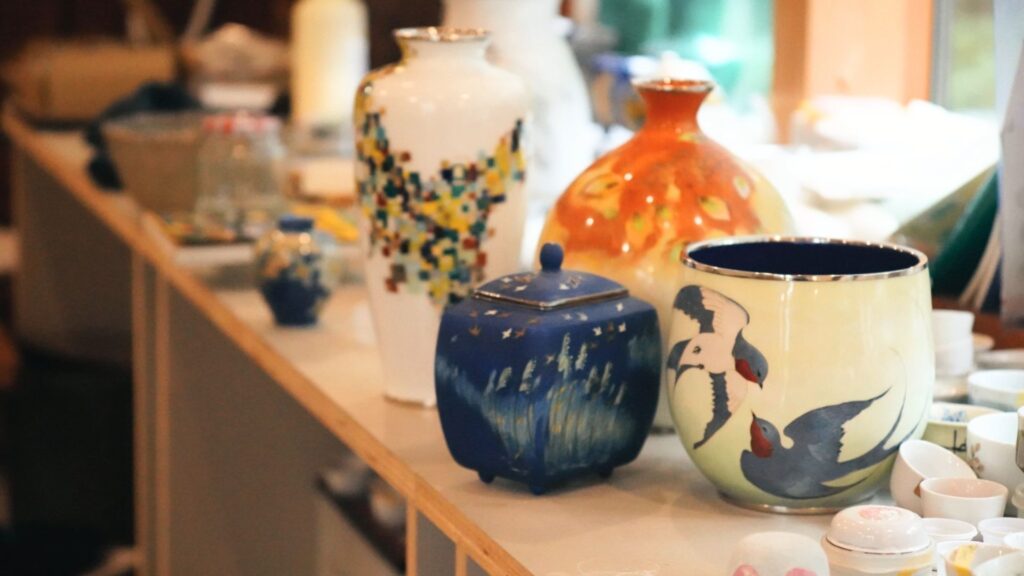
- Look at the design first. Dragons, lotus scrolls and dense symmetrical pattern point one way; birds on branches, seasonal subjects and areas of plain ground point the other
- Check the rim borders. Ruyi-head motifs are a Chinese convention
- Look inside and underneath. Note whether the interior is enamelled and whether exposed metal is gilded
- Examine the wire. Consistent gauge throughout, or variation in width and metal?
- Assess the surface. Ground and polished level with the wires, or left with more texture?
- Weigh the evidence together. Look for several indicators agreeing rather than relying on one
When to stop and ask
If a piece appears to be an early imperial Chinese work or a signed Meiji master piece, the identification is beyond what a checklist can settle, and specialist opinion is worth obtaining before money changes hands.
For everything else, the sequence above will usually place a piece correctly — and the honest answer in ambiguous cases is that it is ambiguous.

TAMURA-SHIPPO 田村七宝工芸
Founded in Meiji 16 (1883). We are a kiln located in Shippo-cho, Ama City, Aichi Prefecture, specializing in “Owari Shippo,” a traditional craft designated by the Ministry of Economy, Trade and Industry. We continue to produce Shippo ware in order to preserve this beautiful traditional culture. The content of this article has been fully supervised by Tamura Shippo Kogei (with AI-generated summaries included), and has been proofread with reference to reliable books and government media sources.