
Japanese Enamel Art: The Meiji Masters, Their Techniques, and Where to See the Work
Between roughly 1880 and 1910, Japanese enamel reached a level of technical refinement that had no precedent, and arguably no sequel. Pieces from those decades sit in major museum collections worldwide.
The period is short, the number of significant makers is small, and the reasons for both the rise and the decline are reasonably well documented.
This guide covers the artists, the techniques they developed, why the golden age ended, and where the work can be seen. We work in the same craft today, in the region most of it came from.
Japanese Enamel Art: What Makes the Meiji Period Distinctive
Japanese enamel art refers principally to work in shippō-yaki — vitreous enamel fused onto metal — and its most celebrated period runs through the Meiji era (1868–1912).
The conditions that produced it
- A newly opened export market. Japanese decorative art reached Europe and America in volume for the first time
- International expositions. Competitive exhibition rewarded technical novelty directly
- Government promotion. The new Meiji state actively promoted craft exports
- A material breakthrough. High-clarity transparent glaze became available
The last of these was decisive. Before the Meiji period Japanese enamel was largely opaque doro shippō, and the development of transparent glaze — work in which the German scientist Gottfried Wagener (1830–1892) played a part — is what made the luminous depth of the period possible.
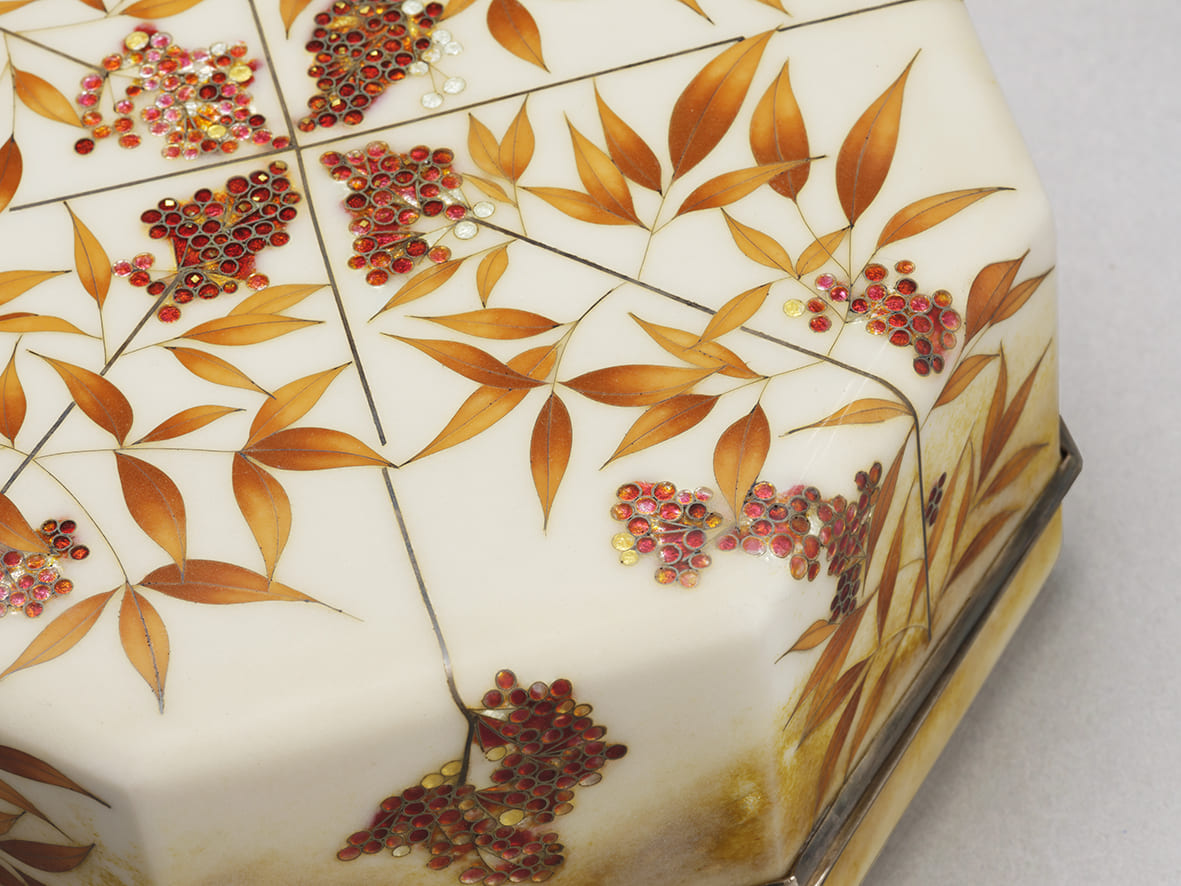
The distinctive achievement of Meiji enamel art was making the technique behave like painting: gradation, atmosphere, and areas of unbroken colour, in a medium that had historically produced flat pattern.
The Major Figures in Japanese Enamel Art
Kaji Tsunekichi (1803–1883)
The starting point for the modern Owari lineage. During the Tenpō era (1830–1844) he worked out a method after studying an enamelled plate brought to Japan by a Dutch trading ship, reportedly breaking the imported object to examine its structure. He is known in Japan as the father of modern shippō.
An important qualification: what Tsunekichi established was opaque doro shippō. The transparent glazes associated with Meiji enamel came from later research.
Namikawa Yasuyuki (1845–1927)
Working in Kyoto, Yasuyuki refined wired enamel to an extreme degree of fineness. His work is characterised by dense, precise wirework and deep grounds against which colour reads with unusual intensity. He was appointed an Imperial Household Artist.
Namikawa Sōsuke (1847–1910)
Working in Tokyo, Sōsuke developed musen shippō, wireless enamel, in which wires are removed before final firing so that colours blend. The technique made it possible to reproduce the atmospheric effects of Japanese painting in enamel. He was also appointed an Imperial Household Artist.
The two are conventionally referred to together, since they share a surname reading despite having no family connection.
The Techniques Developed in Japanese Enamel Art
Several techniques are specifically associated with this period.
| Technique | Japanese | Effect |
|---|---|---|
| Wireless | Musen shippō | Colours blend with no visible outlines |
| Base removed | Shōtai shippō | Translucent; light passes through |
| Foil-backed | Ginbari | Internal shimmer from textured foil beneath transparent glaze |
| Pierced base | Tōtai shippō | Transparent and opaque areas contrasted |
| Raised work | Moriage | Enamel built up above the surface |
Why plain ground was an achievement
Wires were historically used across background areas partly to stop molten enamel from running during firing. Large areas of clear, undivided colour therefore represent solved technical problems rather than simply restraint in design.
This is worth knowing when looking at Meiji enamel: the empty parts of the surface are frequently the difficult parts.
Japanese Enamel Art on the International Stage
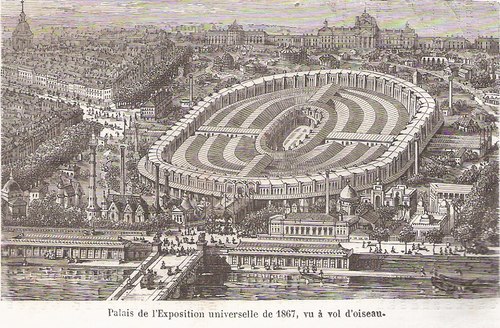
The period’s development is closely tied to a specific series of events.
The expositions
- Paris, 1867 — Japanese enamel shown internationally
- Chicago, 1893
- Paris, 1900 — Japanese enamel drew high praise
- St Louis, 1904
- Japan–British Exhibition, London, 1910
These were not incidental showcases. Exposition medals had direct commercial value, and the competitive framework rewarded exactly the technical innovation that defines the period.
Presentation ware
Enamel was used by the Imperial Household for diplomatic gifts, which placed the highest-quality work outside the commercial market entirely. Pieces made under this system represent the upper limit of what the craft achieved.
Why the Golden Age of Japanese Enamel Art Ended
The decline is usually explained by a combination of factors rather than a single cause.
- Changing export taste. Demand for elaborate Japanese decorative art in Western markets declined in the early twentieth century
- Economic conditions. The interwar period was difficult for luxury export industries generally
- Wartime restriction. Copper, lead oxide, cobalt and manganese were classified as military materials, and production became extremely difficult
- Labour cost. A craft requiring this many skilled hand stages becomes progressively harder to sustain as wages rise
The skills did not vanish suddenly. What disappeared was the market and the material supply that had made work at that level economically possible.
The post-war episode
After 1945 demand returned from an unexpected direction: enamel proved a practical souvenir for occupation personnel returning home, since a metal-bodied object survived the journey where wood, bamboo and paper did not. This sustained the industry through several years, though the work was mostly aimed at a souvenir market rather than at the exhibition standard of the Meiji period.
Where to See Japanese Enamel Art
Museum collections
Meiji enamel is held in institutions internationally, including the Victoria and Albert Museum, the Walters Art Museum, and the Ashmolean Museum, as well as in the Khalili Collection of Japanese Art.
Museum attributions are the most reliable reference points available, because they have been examined by specialists — which matters in a field where high-value names are frequently attached to pieces that do not warrant them.
In Japan
- The Namikawa Yasuyuki Cloisonné Museum in Kyoto, in his former residence and workshop
- Ama City Shippō-yaki Art Village in Aichi, in the production region
- Japanese national and prefectural museum collections holding Meiji decorative art
What to look at when you get there
Two observations tell you most of what a piece can tell you.
First, find the tightest curve in the design and look at the wire. Second, look across the surface at a low angle to see whether it is genuinely flat.
These are the same two checks a working enameller uses, and they apply equally to a museum piece and to something on a shop shelf.
Japanese Enamel Art Today
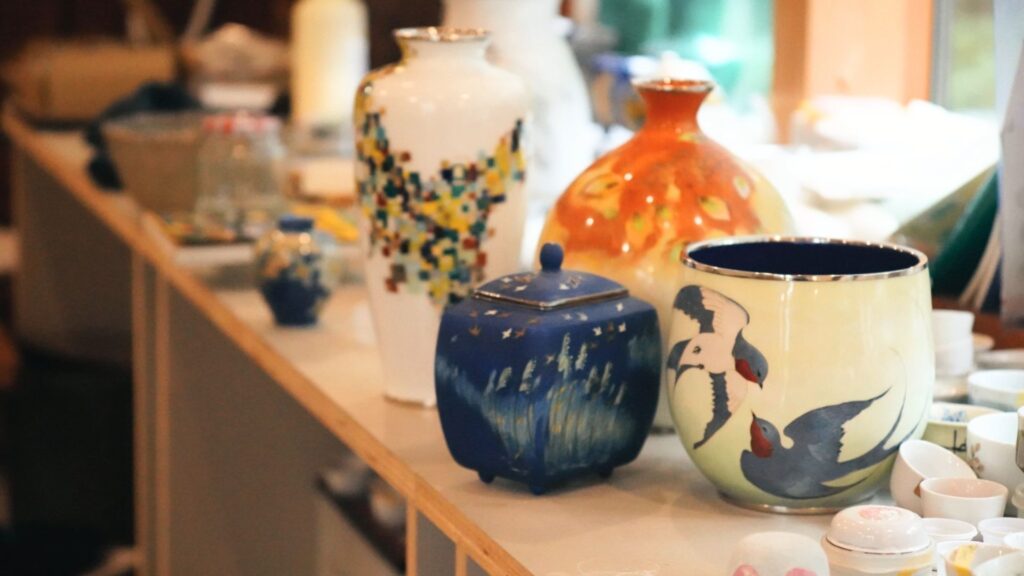
The craft continues, at much reduced scale.
Owari shippō, produced in Ama City and Nagoya City, was designated a national Traditional Craft Product on 5 April 1995. As of May 2017, the two producers’ cooperatives in the region had eight and seven member businesses respectively.
What has changed
- Scale of objects. Fewer large display vases, more jewellery and small pieces, reflecting changes in Japanese homes
- Market. Domestic gifts and commemorative pieces rather than bulk export
- Structure. The same divided-labour workshop system, with fewer people in it
What has not
The process is essentially unchanged: metal formed first, wires bent and set by hand, glaze applied compartment by compartment, repeated firings at around 800°C, then grinding and polishing by hand.
Source: Aichi Prefecture, Traditional Crafts of Aichi — Owari Shippō.
Whether the Meiji standard could be reached again is a question about economics rather than about knowledge — the constraint is how many hours of skilled hand work a finished object can carry and still find a buyer.

TAMURA-SHIPPO 田村七宝工芸
Founded in Meiji 16 (1883). We are a kiln located in Shippo-cho, Ama City, Aichi Prefecture, specializing in “Owari Shippo,” a traditional craft designated by the Ministry of Economy, Trade and Industry. We continue to produce Shippo ware in order to preserve this beautiful traditional culture. The content of this article has been fully supervised by Tamura Shippo Kogei (with AI-generated summaries included), and has been proofread with reference to reliable books and government media sources.